

Open prompts
sample 03 AI Image Prompt
sample 03, its complete AI image prompt, and the Photography & Cinematic Styles · Vector · Bright · 119 style are free to view and copy.
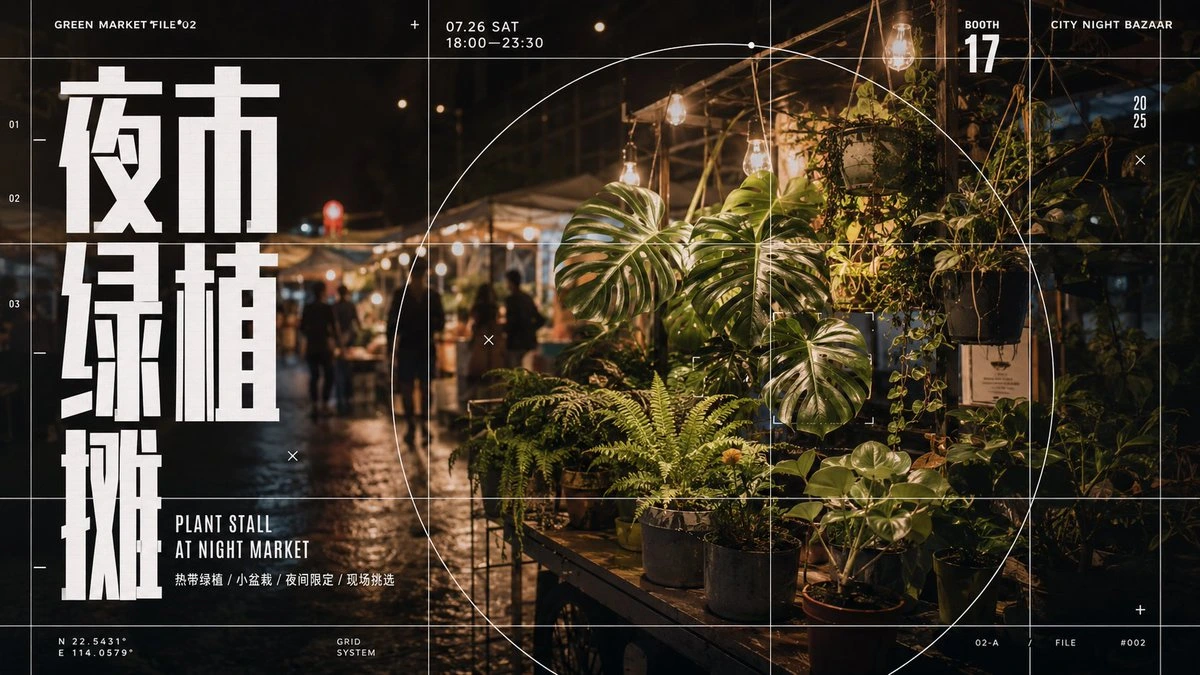
Complete AI image prompt
Build the first read around a controlled collision between full-bleed documentary photography and an oversized custom headline. Give the theme carrier a highly recognizable near or medium-close silhouette, a natural gesture, and sharply resolved material cues, while a dense headline of comparable visual weight presses against and partially beyond an image edge. Construct the display lettering as bold architectural white shapes: compressed proportions and leading, powerful vertical and horizontal strokes, squared structure, decisive cut terminals, optically corrected counters, and valid, legible anatomy for the chosen writing system; theme meaning may alter component scale and rhythm without sacrificing recognition. Hold the image in asymmetric dynamic equilibrium: the headline mass and photographic subject oppose or lightly overlap one another, environmental breathing space supplies direction, and peripheral information acts as a fine counterweight. Lead the eye from the type-subject collision along gesture, contour, or perspective into the setting, then return it toward the focal area through marginal annotations and scales. Lay a precise viewfinder and survey interface across the entire image with hairline orthogonal divisions, a few very large circular arcs or concentric paths, crosshairs, short ticks, coordinates, sequence numbers, plus signs, and targeting brackets. These lines pass continuously across type, subject, and environment while preserving recognition; arcs enclose the key carrier, the grid establishes scale, and one controlled contour break lets the subject resist the system. Generate a believable theme-specific information hierarchy: one monumental headline, an adjacent medium functional line, narrow sans-serif secondary copy, dates, identifiers, location or parameter-like microcopy, and sparse monoline icons in simple square containers. Set supporting text with tall proportions, narrow widths, open tracking, and disciplined baselines, alternating compact and airy clusters along margins and lower edges. Keep the photography optically credible, with natural spatial depth, skin or material response, a decisive focal plane on the most identifying detail, softened foreground and distance planes, and clean critical contours. Let the theme determine the setting, action, props, symbolic attachments, hues, and plausible light source; unify the field through one environment-derived temperature or near-monochrome family, then use bright white information graphics and limited subject-born highlights for strong value contrast. In dark settings, use localized warm illumination, rim light, and deep environmental blacks; in bright settings, use lucid daylight and gentle highlight rolloff; for close material studies, let reflections and fine construction detail provide evidence. Across every lighting class, keep the interface and lettering crisp, fine, and immaculate while the photographic layer retains continuous tone and authentic lens behavior. The final system should feel like a live scene fused with a research archive and camera-monitor overlay: information-rich but rigorously ranked, with giant type, subject, environmental perspective, and measurement marks all explaining the same focal event.
Original style prompt
Build the first read around a controlled collision between full-bleed documentary photography and an oversized custom headline. Give the theme carrier a highly recognizable near or medium-close silhouette, a natural gesture, and sharply resolved material cues, while a dense headline of comparable visual weight presses against and partially beyond an image edge. Construct the display lettering as bold architectural white shapes: compressed proportions and leading, powerful vertical and horizontal strokes, squared structure, decisive cut terminals, optically corrected counters, and valid, legible anatomy for the chosen writing system; theme meaning may alter component scale and rhythm without sacrificing recognition. Hold the image in asymmetric dynamic equilibrium: the headline mass and photographic subject oppose or lightly overlap one another, environmental breathing space supplies direction, and peripheral information acts as a fine counterweight. Lead the eye from the type-subject collision along gesture, contour, or perspective into the setting, then return it toward the focal area through marginal annotations and scales. Lay a precise viewfinder and survey interface across the entire image with hairline orthogonal divisions, a few very large circular arcs or concentric paths, crosshairs, short ticks, coordinates, sequence numbers, plus signs, and targeting brackets. These lines pass continuously across type, subject, and environment while preserving recognition; arcs enclose the key carrier, the grid establishes scale, and one controlled contour break lets the subject resist the system. Generate a believable theme-specific information hierarchy: one monumental headline, an adjacent medium functional line, narrow sans-serif secondary copy, dates, identifiers, location or parameter-like microcopy, and sparse monoline icons in simple square containers. Set supporting text with tall proportions, narrow widths, open tracking, and disciplined baselines, alternating compact and airy clusters along margins and lower edges. Keep the photography optically credible, with natural spatial depth, skin or material response, a decisive focal plane on the most identifying detail, softened foreground and distance planes, and clean critical contours. Let the theme determine the setting, action, props, symbolic attachments, hues, and plausible light source; unify the field through one environment-derived temperature or near-monochrome family, then use bright white information graphics and limited subject-born highlights for strong value contrast. In dark settings, use localized warm illumination, rim light, and deep environmental blacks; in bright settings, use lucid daylight and gentle highlight rolloff; for close material studies, let reflections and fine construction detail provide evidence. Across every lighting class, keep the interface and lettering crisp, fine, and immaculate while the photographic layer retains continuous tone and authentic lens behavior. The final system should feel like a live scene fused with a research archive and camera-monitor overlay: information-rich but rigorously ranked, with giant type, subject, environmental perspective, and measurement marks all explaining the same focal event.
More open images in the “Photography & Cinematic Styles · Vector · Bright · 119” style