

Open prompts
sample 03 AI Image Prompt
sample 03, its complete AI image prompt, and the Typography & Posters · Vector · Bright · 257 style are free to view and copy.
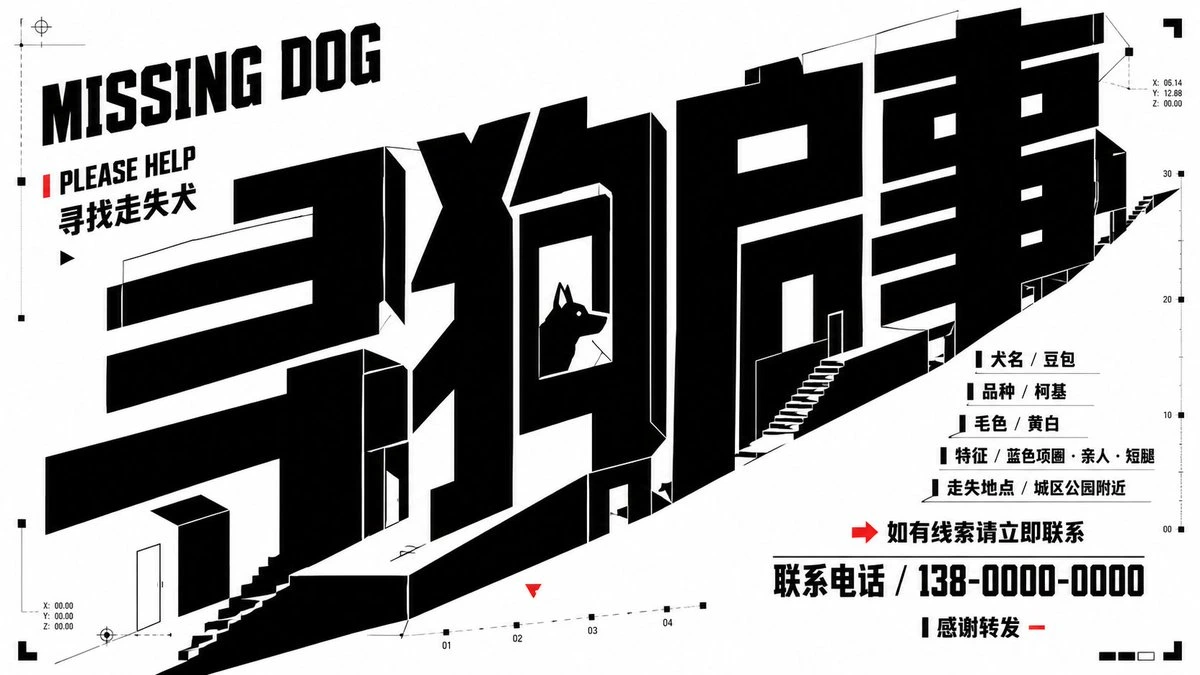
Complete AI image prompt
Turn the theme's core phrase into a monumental typographic structure that controls the first read. Build it from an ultra-heavy display skeleton that remains valid and unmistakably legible in the chosen writing system: compress glyph proportions, enlarge the principal strokes, and interlock consecutive glyphs through abrupt jumps in width and scale until they form one dominant black skyline. Extrude deep side planes directly from the strokes, converting bars, stems, joints, and counters into roofs, facades, cantilevers, entrances, and internal courts, so the phrase reads simultaneously as language and as architecture that could be entered. Use an oblique low viewpoint and dynamic asymmetrical balance; give this primary mass roughly three quarters of the visual weight, drive it along a rising or advancing axis, and let selected contours press against the field edges while generous unprinted white surrounds the structure and penetrates its counters. Establish depth through overlap, converging contours, and progressively shortened side planes, then let one theme-motivated section break the orderly baseline or modular grid to create a decisive upward, forward, or falling vector. Make secondary theme information inhabit the glyph structure: a limited set of stairs, ramps, narrow doors, windows, platforms, and bridging slabs must grow from the stroke topology and remain delicate enough to reveal the giant scale. When the theme calls for a symbol, reduce one theme-supplied motif to a crisp black silhouette and place it inside a counter, doorway, or sign frame as a narrative clue subordinate to word recognition. Construct the entire figure-ground system from undimmed white and broad areas of flat solid black: black serves as both printed letterface and built mass, while white serves as paper field, cutout, passage, and illuminated plane. Allow one highly saturated accent hue supplied by the theme's emotional temperature or functional signal, confined to tiny numbers, arrows, short rules, nodes, or price strikes as precise pulses. Relegate supporting information to a lightweight technical-editorial layer: condensed sans-serif captions, short notices, indexed numbers, coordinates, scale ticks, dimension leaders, crosshairs, corner marks, fine frames, dotted rules, and miniature barcode rhythms should form disciplined modules along open margins and negative spaces. Preserve correct orthography in every script and align multilingual text by optical weight rather than nominal size. Maintain an extreme scale contrast between micro-information and the monumental phrase; occasional hairlines may connect to architectural corners, but the primary silhouette stays continuous and forceful. Render hard-edged vector facets, straight wall lines, acute diagonal cuts, and even matte ink fields; describe volume through alternating black and white planes instead of continuous shading, with very fine black construction lines reserved for white facades. The final system should feel like precision drafting colliding with an urgent public notice: the eye enters through the semantic megastructure, explores its inhabitable details, then lands on peripheral information indices, while recognizable lettering—not an ordinary building—remains the governing form.
Original style prompt
Turn the theme's core phrase into a monumental typographic structure that controls the first read. Build it from an ultra-heavy display skeleton that remains valid and unmistakably legible in the chosen writing system: compress glyph proportions, enlarge the principal strokes, and interlock consecutive glyphs through abrupt jumps in width and scale until they form one dominant black skyline. Extrude deep side planes directly from the strokes, converting bars, stems, joints, and counters into roofs, facades, cantilevers, entrances, and internal courts, so the phrase reads simultaneously as language and as architecture that could be entered. Use an oblique low viewpoint and dynamic asymmetrical balance; give this primary mass roughly three quarters of the visual weight, drive it along a rising or advancing axis, and let selected contours press against the field edges while generous unprinted white surrounds the structure and penetrates its counters. Establish depth through overlap, converging contours, and progressively shortened side planes, then let one theme-motivated section break the orderly baseline or modular grid to create a decisive upward, forward, or falling vector. Make secondary theme information inhabit the glyph structure: a limited set of stairs, ramps, narrow doors, windows, platforms, and bridging slabs must grow from the stroke topology and remain delicate enough to reveal the giant scale. When the theme calls for a symbol, reduce one theme-supplied motif to a crisp black silhouette and place it inside a counter, doorway, or sign frame as a narrative clue subordinate to word recognition. Construct the entire figure-ground system from undimmed white and broad areas of flat solid black: black serves as both printed letterface and built mass, while white serves as paper field, cutout, passage, and illuminated plane. Allow one highly saturated accent hue supplied by the theme's emotional temperature or functional signal, confined to tiny numbers, arrows, short rules, nodes, or price strikes as precise pulses. Relegate supporting information to a lightweight technical-editorial layer: condensed sans-serif captions, short notices, indexed numbers, coordinates, scale ticks, dimension leaders, crosshairs, corner marks, fine frames, dotted rules, and miniature barcode rhythms should form disciplined modules along open margins and negative spaces. Preserve correct orthography in every script and align multilingual text by optical weight rather than nominal size. Maintain an extreme scale contrast between micro-information and the monumental phrase; occasional hairlines may connect to architectural corners, but the primary silhouette stays continuous and forceful. Render hard-edged vector facets, straight wall lines, acute diagonal cuts, and even matte ink fields; describe volume through alternating black and white planes instead of continuous shading, with very fine black construction lines reserved for white facades. The final system should feel like precision drafting colliding with an urgent public notice: the eye enters through the semantic megastructure, explores its inhabitable details, then lands on peripheral information indices, while recognizable lettering—not an ordinary building—remains the governing form.
More open images in the “Typography & Posters · Vector · Bright · 257” style