

Open prompts
sample 03 AI Image Prompt
sample 03, its complete AI image prompt, and the Travel, Cities & Architecture · Impasto · Oil Painting · 074 style are free to view and copy.
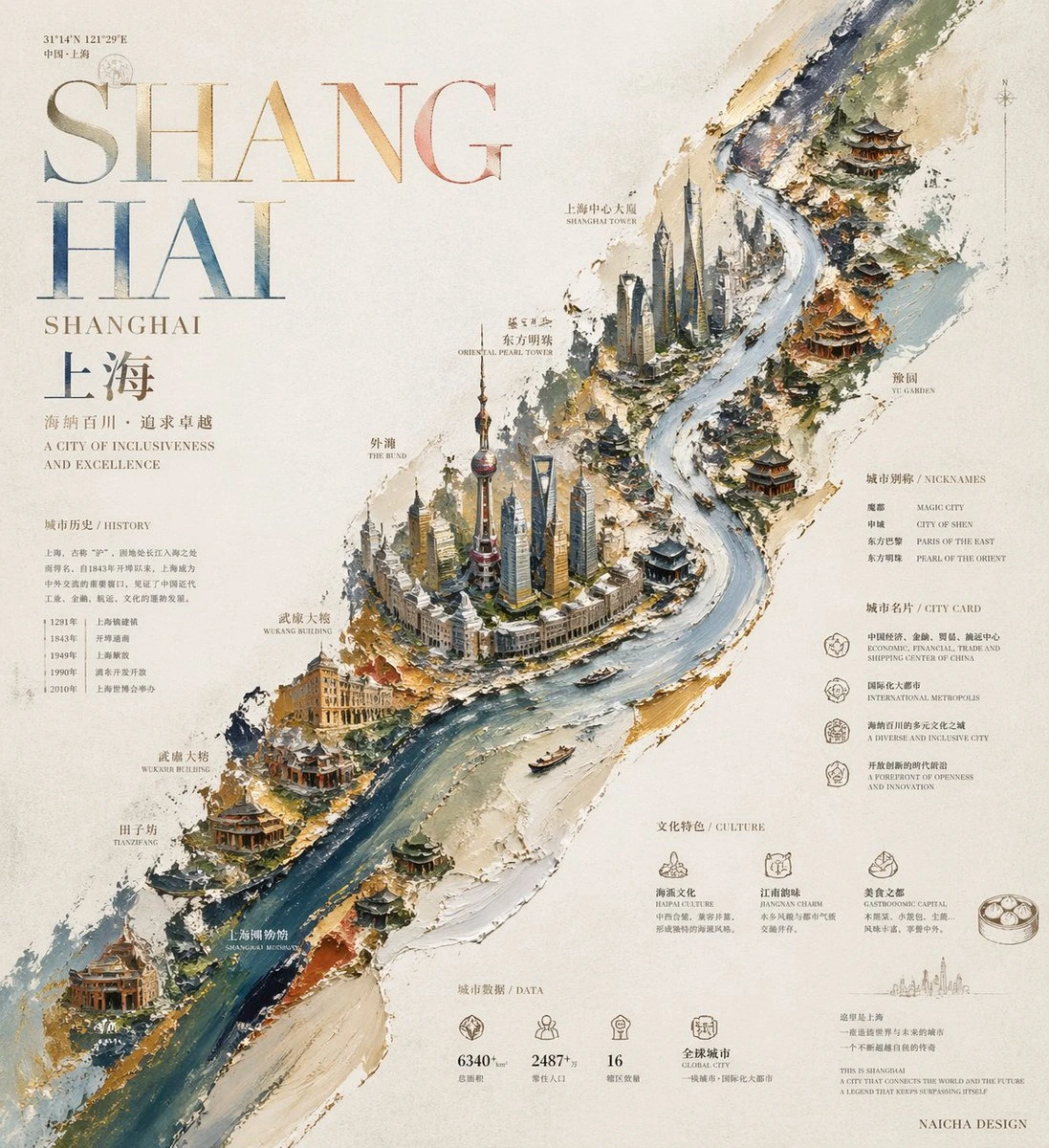
Complete AI image prompt
Compress the theme into an explorable miniature narrative terrain, building its key forms, symbolic cues, material relationships, and chronology into one continuous ribbon or island-like model. Give the main route a broad diagonal or serpentine sweep; arrange its nodes as a semantic progression, so the eye enters through a dense near-field cluster, encounters one or two dramatic jumps in scale, and travels toward a quieter distant resolution. This terrain carries roughly two thirds of the visual weight while a generous warm ivory field provides the counterweight. Treat that open field as an active interval shared by model, title, and annotation: supporting type becomes lighter beside dense scenery, while the display title gains monumental presence across broader pauses, producing stable asymmetrical balance. Let the theme determine one coherent tactile mode within a strict range. At one end, construct the terrain as a precise axonometric miniature with clearly interlocking modules, stepped strata, tiny components, and soft contact shadows that reveal scale. At the other, keep the semantic nodes crisp and model-like while joining them with palette-knife impasto, translucent washes, and swift dry-brush releases that open into the paper; recognizable focal contours remain intact. Use one mode as the governing material logic throughout. Derive a low-chroma dark structural family, a cool flowing family, and sparse warm accents from the theme itself. Alternate cool and warm roles along the route to articulate depth, allow the brightest paper tone to pass through gaps in the terrain, echo restrained segments of this palette in the display lettering, and keep informational copy in deep gray-brown. Build an oversized high-contrast title in the writing system required by the theme, using slender proportions, strong thick-thin modulation, sharp wedge terminals, valid counters and joins, and open tracking. Set the theme name as a more compact second tier in its native script, coordinating different scripts by optical mass and rhythm rather than nominal point size while preserving correct orthographic anatomy. Break concise, credible theme information into airy micro-columns around the main terrain, supported by hairline leaders, coordinate-like numerals, legends, directional marks, consistent linear icons, and one small seal-like accent; the result should read as an illustrated field guide and knowledge archive, always subordinate to the title and terrain. Resolve focal nodes with fine structure, layered occlusion, and tiny signs of activity, then compress distant nodes through diminishing scale and softer contrast. Keep the open field as warm matte uncoated paper with visible fibers, confining applied material behavior to the thematic terrain and selectively colored title layer. Maintain immediate macro silhouette, a traceable middle-distance route, and rewarding close-read annotation, unifying handmade tactility, miniature-model order, and the precision of an information atlas.
Original style prompt
Compress the theme into an explorable miniature narrative terrain, building its key forms, symbolic cues, material relationships, and chronology into one continuous ribbon or island-like model. Give the main route a broad diagonal or serpentine sweep; arrange its nodes as a semantic progression, so the eye enters through a dense near-field cluster, encounters one or two dramatic jumps in scale, and travels toward a quieter distant resolution. This terrain carries roughly two thirds of the visual weight while a generous warm ivory field provides the counterweight. Treat that open field as an active interval shared by model, title, and annotation: supporting type becomes lighter beside dense scenery, while the display title gains monumental presence across broader pauses, producing stable asymmetrical balance. Let the theme determine one coherent tactile mode within a strict range. At one end, construct the terrain as a precise axonometric miniature with clearly interlocking modules, stepped strata, tiny components, and soft contact shadows that reveal scale. At the other, keep the semantic nodes crisp and model-like while joining them with palette-knife impasto, translucent washes, and swift dry-brush releases that open into the paper; recognizable focal contours remain intact. Use one mode as the governing material logic throughout. Derive a low-chroma dark structural family, a cool flowing family, and sparse warm accents from the theme itself. Alternate cool and warm roles along the route to articulate depth, allow the brightest paper tone to pass through gaps in the terrain, echo restrained segments of this palette in the display lettering, and keep informational copy in deep gray-brown. Build an oversized high-contrast title in the writing system required by the theme, using slender proportions, strong thick-thin modulation, sharp wedge terminals, valid counters and joins, and open tracking. Set the theme name as a more compact second tier in its native script, coordinating different scripts by optical mass and rhythm rather than nominal point size while preserving correct orthographic anatomy. Break concise, credible theme information into airy micro-columns around the main terrain, supported by hairline leaders, coordinate-like numerals, legends, directional marks, consistent linear icons, and one small seal-like accent; the result should read as an illustrated field guide and knowledge archive, always subordinate to the title and terrain. Resolve focal nodes with fine structure, layered occlusion, and tiny signs of activity, then compress distant nodes through diminishing scale and softer contrast. Keep the open field as warm matte uncoated paper with visible fibers, confining applied material behavior to the thematic terrain and selectively colored title layer. Maintain immediate macro silhouette, a traceable middle-distance route, and rewarding close-read annotation, unifying handmade tactility, miniature-model order, and the precision of an information atlas.
More open images in the “Travel, Cities & Architecture · Impasto · Oil Painting · 074” style