

Open prompts
sample 03 AI Image Prompt
sample 03, its complete AI image prompt, and the Photo Restyling · Pixel Art · 3D · 199 style are free to view and copy.
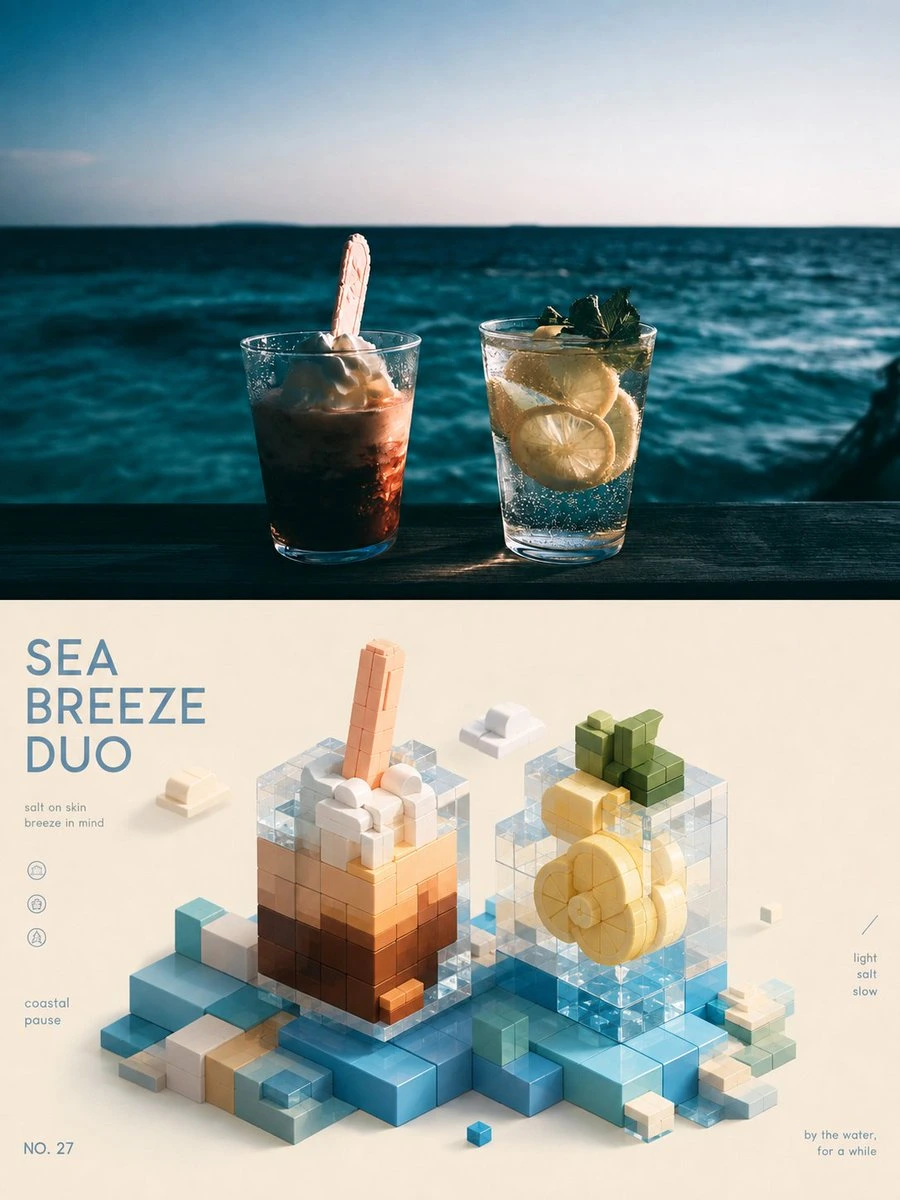
Complete AI image prompt
Build the first read around a credible real-world prototype of the chosen subject, then let a crisp horizontal transition reveal the same subject reconstructed as a tactile explanatory model. The realistic field preserves the subject’s most recognizable silhouette, proportions, attachments, environmental cues, and sense of scale through restrained cinematic photography, a legible horizon or support plane, and natural light whose temperature follows the subject’s emotional register. In the constructed field, repeat the identity and stance while breaking continuous surfaces, joints, and nearby scenery into a limited kit of blocks, cylinders, discs, plates, transparent volumes, or precise metallic contour work. Keep the abstraction visibly modular but retain the decisive openings, rims, crowns, foliage, appendages, and symbolic markers generated by the subject itself. Bind both fields into a prototype-to-model correspondence: the main mass outweighs all annotation, while a shared horizontal axis, approximate reflection, contour closure, or repeated rhythm makes each version explain the other. Select a frontal, profile, or lightly isometric model view according to structural clarity; preserve a stable center of gravity, a low modular plinth, generous breathing room, and only enough theme-derived setting pieces to establish scale and narrative. Derive one dominant hue family, one support family, and very sparse accents from the real scene. Let photography retain natural warm-cool and light-dark variation, then compress those relationships into clean color masses and adjacent value steps in the model. Translate transparent, reflective, mineral, botanical, and soft materials through clear interlocking units, bright edge returns, matte solids, clustered fine forms, and rounded modules, so color describes construction as well as mood. Finish the model like a collectible miniature with softened corners, exact seams, gentle contact shadows, controlled highlights, and crisp continuous edges. When the subject calls for monumentality rather than playfulness, condense the same construction grammar into monochrome foil-like linework, shallow embossed detail, and axial symmetry, using either a pale open field or a deep matte field to isolate a luminous architectural silhouette. Treat lettering as a quiet editorial layer: one subject-derived short title creates the only major scale jump, while widely tracked microcopy, numbering, hairlines, dots, and tiny functional icons retreat into the surrounding emptiness. Choose within a bounded range from refined high-contrast serif anatomy to clear geometric sans-serif anatomy according to tone, preserving valid glyph topology, light weight, open spacing, and calm reading rhythm. The result feels precise, still, observant, and collectible: reality and construction interpret one another, and the subject’s form, symbolism, material logic, color sources, and narrative are visibly recoded rather than merely decorated.
Original style prompt
Build the first read around a credible real-world prototype of the chosen subject, then let a crisp horizontal transition reveal the same subject reconstructed as a tactile explanatory model. The realistic field preserves the subject’s most recognizable silhouette, proportions, attachments, environmental cues, and sense of scale through restrained cinematic photography, a legible horizon or support plane, and natural light whose temperature follows the subject’s emotional register. In the constructed field, repeat the identity and stance while breaking continuous surfaces, joints, and nearby scenery into a limited kit of blocks, cylinders, discs, plates, transparent volumes, or precise metallic contour work. Keep the abstraction visibly modular but retain the decisive openings, rims, crowns, foliage, appendages, and symbolic markers generated by the subject itself. Bind both fields into a prototype-to-model correspondence: the main mass outweighs all annotation, while a shared horizontal axis, approximate reflection, contour closure, or repeated rhythm makes each version explain the other. Select a frontal, profile, or lightly isometric model view according to structural clarity; preserve a stable center of gravity, a low modular plinth, generous breathing room, and only enough theme-derived setting pieces to establish scale and narrative. Derive one dominant hue family, one support family, and very sparse accents from the real scene. Let photography retain natural warm-cool and light-dark variation, then compress those relationships into clean color masses and adjacent value steps in the model. Translate transparent, reflective, mineral, botanical, and soft materials through clear interlocking units, bright edge returns, matte solids, clustered fine forms, and rounded modules, so color describes construction as well as mood. Finish the model like a collectible miniature with softened corners, exact seams, gentle contact shadows, controlled highlights, and crisp continuous edges. When the subject calls for monumentality rather than playfulness, condense the same construction grammar into monochrome foil-like linework, shallow embossed detail, and axial symmetry, using either a pale open field or a deep matte field to isolate a luminous architectural silhouette. Treat lettering as a quiet editorial layer: one subject-derived short title creates the only major scale jump, while widely tracked microcopy, numbering, hairlines, dots, and tiny functional icons retreat into the surrounding emptiness. Choose within a bounded range from refined high-contrast serif anatomy to clear geometric sans-serif anatomy according to tone, preserving valid glyph topology, light weight, open spacing, and calm reading rhythm. The result feels precise, still, observant, and collectible: reality and construction interpret one another, and the subject’s form, symbolism, material logic, color sources, and narrative are visibly recoded rather than merely decorated.
More open images in the “Photo Restyling · Pixel Art · 3D · 199” style