

Open prompts
sample 03 AI Image Prompt
sample 03, its complete AI image prompt, and the Travel, Cities & Architecture · Glass · Paper Texture · 069 style are free to view and copy.
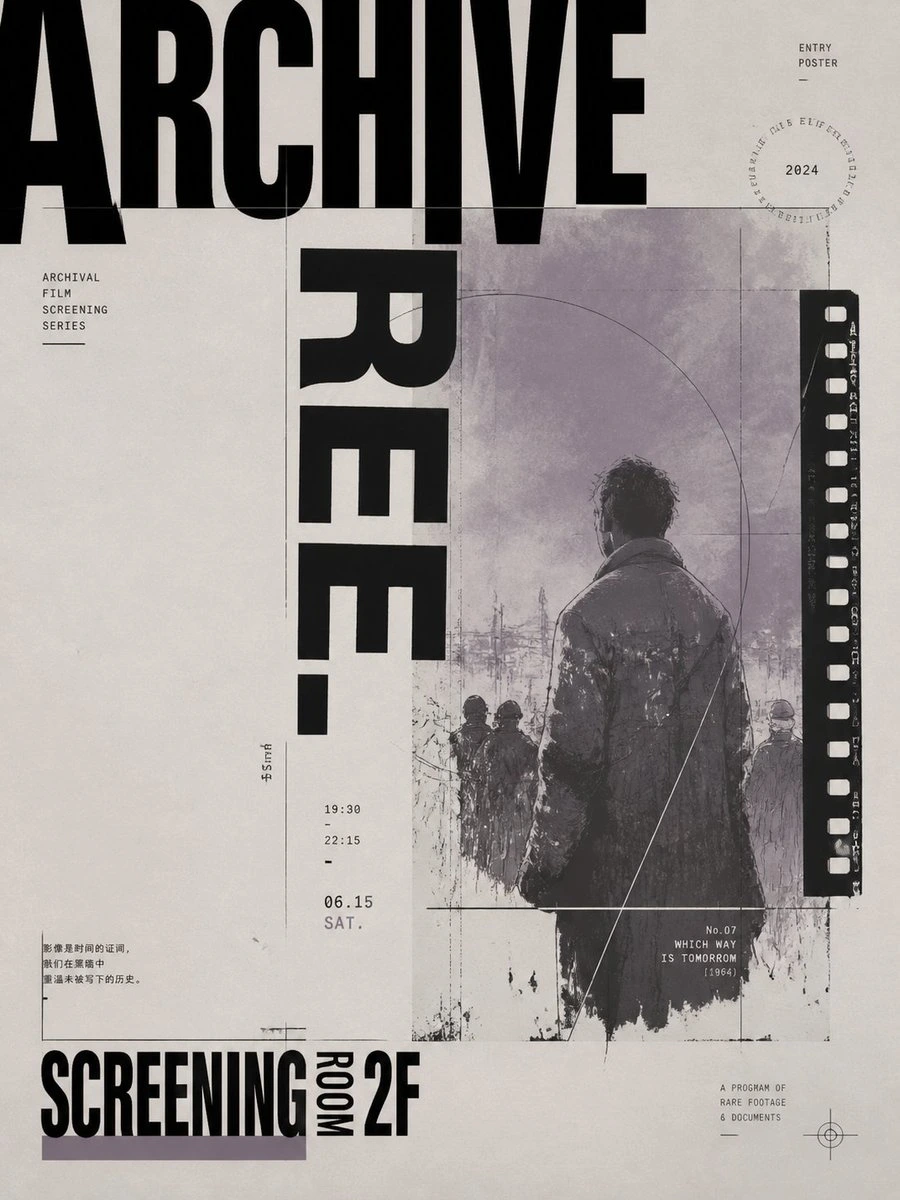
Complete AI image prompt
Build the first read from monumental, ultra-bold condensed sans lettering that outweighs all secondary information by roughly four to one. Push glyphs into the frame edges, crop selected strokes, split or rotate portions of the title, and use the dense black counters and stems simultaneously as structure, windows, masks, and image frames. Preserve valid anatomy for the chosen writing system through a tall center of gravity, low stroke contrast, compressed width, squared counters, and tightly packed display rhythm. Translate the theme's most recognizable form into an archival evidence layer, led by one precise mode—technical line drawing, sectional drafting, mapped grid, photography, or object collage—with a second mode allowed only as a localized overlap. Thread this evidence through the letterforms: cross column rules, enter counters, alternate occlusion with the title, concentrate detail around the semantic core, then let peripheral contours dissolve into open paper. Govern the composition with an asymmetric compound editorial grid: one typographic mass and one intricate thematic image hold a tense equilibrium while roughly one third to one half of the field remains quiet. The eye should strike the edge-pressured title first, travel along the image's diagonal or vertical logic, and settle in airy marginal and lower index zones. Thin rules, measurement circles, crosshairs, coordinate points, leader lines, sequence numbers, and compact seals restore calibration after deliberate grid breaks. Enforce a steep four-level hierarchy of display type, evidence image, narrow-column heading, and micro annotation; set supporting copy in monospaced or mechanically condensed forms with open tracking, short rules, and optically balanced multilingual scripts. Let theme-derived information occupy naming, classification, time, place, and catalog-note roles. Use warm uncoated ivory paper as a broad matte field, coal black or deep ink for the dominant structure, one or two muted support hues drawn from the theme's material and emotional logic, and a very small indexing accent of dark terracotta, olive, indigo, or a semantic equivalent. Construct the print surface as archival reproduction: uneven ink uptake and repeated transfer expose tiny flecks of paper and intermittent edges inside the largest black forms only, while open paper and microtype remain clear; localized two-ink registration may shift slightly in one consistent direction so colored contours read as recorded evidence. Keep the tone disciplined, investigative, and culturally editorial, balancing typographic pressure, forensic thematic detail, and the measured order of technical notation.
Original style prompt
Build the first read from monumental, ultra-bold condensed sans lettering that outweighs all secondary information by roughly four to one. Push glyphs into the frame edges, crop selected strokes, split or rotate portions of the title, and use the dense black counters and stems simultaneously as structure, windows, masks, and image frames. Preserve valid anatomy for the chosen writing system through a tall center of gravity, low stroke contrast, compressed width, squared counters, and tightly packed display rhythm. Translate the theme's most recognizable form into an archival evidence layer, led by one precise mode—technical line drawing, sectional drafting, mapped grid, photography, or object collage—with a second mode allowed only as a localized overlap. Thread this evidence through the letterforms: cross column rules, enter counters, alternate occlusion with the title, concentrate detail around the semantic core, then let peripheral contours dissolve into open paper. Govern the composition with an asymmetric compound editorial grid: one typographic mass and one intricate thematic image hold a tense equilibrium while roughly one third to one half of the field remains quiet. The eye should strike the edge-pressured title first, travel along the image's diagonal or vertical logic, and settle in airy marginal and lower index zones. Thin rules, measurement circles, crosshairs, coordinate points, leader lines, sequence numbers, and compact seals restore calibration after deliberate grid breaks. Enforce a steep four-level hierarchy of display type, evidence image, narrow-column heading, and micro annotation; set supporting copy in monospaced or mechanically condensed forms with open tracking, short rules, and optically balanced multilingual scripts. Let theme-derived information occupy naming, classification, time, place, and catalog-note roles. Use warm uncoated ivory paper as a broad matte field, coal black or deep ink for the dominant structure, one or two muted support hues drawn from the theme's material and emotional logic, and a very small indexing accent of dark terracotta, olive, indigo, or a semantic equivalent. Construct the print surface as archival reproduction: uneven ink uptake and repeated transfer expose tiny flecks of paper and intermittent edges inside the largest black forms only, while open paper and microtype remain clear; localized two-ink registration may shift slightly in one consistent direction so colored contours read as recorded evidence. Keep the tone disciplined, investigative, and culturally editorial, balancing typographic pressure, forensic thematic detail, and the measured order of technical notation.
More open images in the “Travel, Cities & Architecture · Glass · Paper Texture · 069” style