

Open prompts
sample 03 AI Image Prompt
sample 03, its complete AI image prompt, and the Travel, Cities & Architecture · Line Art · Vector · 079 style are free to view and copy.
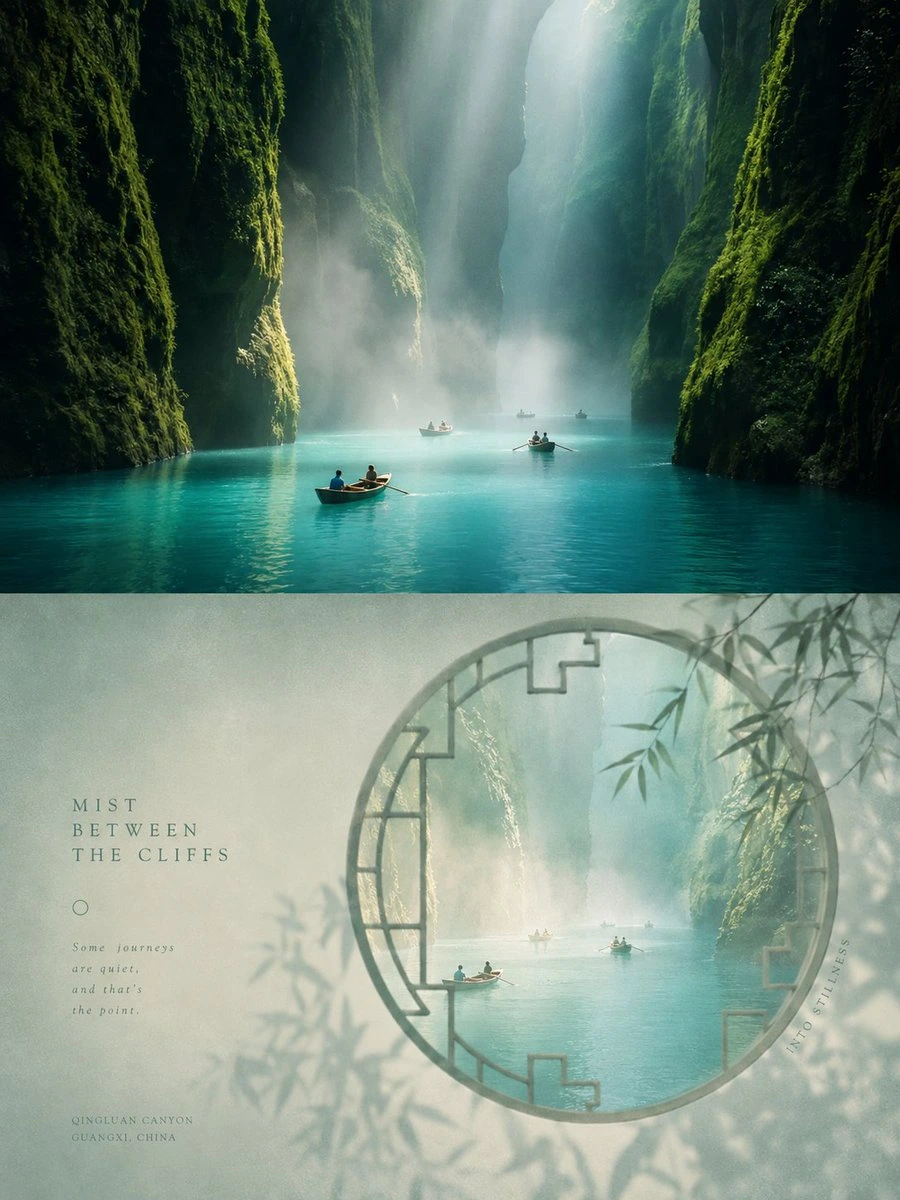
Complete AI image prompt
Stage the subject as a two-state act of seeing: first establish it through lucid, immediate photography with a believable environment, scale cues, narrative timing, and enough visual density for the main form or landscape to press against the edges; then re-author the same subject inside a warm paper-white field as restrained East Asian editorial imagery, preserving its most recognizable silhouette, gesture, depth structure, and symbolic relationships while changing the mode of attention. Separate the two states with a clean horizontal break that reads as a rhythmic cut from occurrence to contemplation. In the interpretive state, let the principal image occupy roughly one half to two thirds of the paper field and balance the remaining openness asymmetrically; the focal mass may sit away from the geometric center, counterweighted at a distance by tiny type, a seal-like mark, or a faint thematic shadow. Build a viewing aperture from the subject's own meaningful geometry, using a circular, clipped-corner, or otherwise theme-derived lattice frame with thin stable members. Place a reduced echo of the photographic scene inside its open or translucent center, allow selected forms to cross the boundary, and create a controlled tension between enclosure and escape. Extend the atmosphere outside the aperture with sparse, low-contrast foliage-like silhouettes, projected shadows, or motifs derived from the subject, keeping their edges soft and their visual weight subordinate. Let emotional temperature control a bounded continuum of rendering. Quiet, expansive, inward material becomes a low-chroma analogous palette with diffused illumination, translucent overlays, and atmospheric depth that keeps nearer forms more legible while progressively compressing contrast in the distance. Urgent, documentary, or defiant material becomes precise black pen contour drawing with varied line density, short directional hatching, and a large flat-black ground that locks the subject into a decisive figure-ground exchange; extract only one small, high-chroma accent from the subject as a visual pulse. Across this continuum, preserve identity, action relationships, and spatial evidence, and let the photographic state's light and color generate the palette of the reinterpretation. Set the information layer in very small, light-weight lettering with wide tracking and generous leading, arranged as short lines, index-like numerals, date rhythms, or curved marginal notes that answer the aperture and activate the empty field. Derive the wording and hierarchy from the subject; keep every glyph structurally valid for the chosen writing system, and close the reading path with one tiny square seal-like sign. Maintain an even matte paper field, crisp continuous contours, dense flat black, and smoothly graduated transparency in luminous areas. The resulting authorship must stay causally legible: the first state records what happens, the second state considers what it means, while aperture, line, open space, micro-typography, and a single accent turn any subject into a quiet cultural narrative with documentary credibility and veiled poetic depth.
Original style prompt
Stage the subject as a two-state act of seeing: first establish it through lucid, immediate photography with a believable environment, scale cues, narrative timing, and enough visual density for the main form or landscape to press against the edges; then re-author the same subject inside a warm paper-white field as restrained East Asian editorial imagery, preserving its most recognizable silhouette, gesture, depth structure, and symbolic relationships while changing the mode of attention. Separate the two states with a clean horizontal break that reads as a rhythmic cut from occurrence to contemplation. In the interpretive state, let the principal image occupy roughly one half to two thirds of the paper field and balance the remaining openness asymmetrically; the focal mass may sit away from the geometric center, counterweighted at a distance by tiny type, a seal-like mark, or a faint thematic shadow. Build a viewing aperture from the subject's own meaningful geometry, using a circular, clipped-corner, or otherwise theme-derived lattice frame with thin stable members. Place a reduced echo of the photographic scene inside its open or translucent center, allow selected forms to cross the boundary, and create a controlled tension between enclosure and escape. Extend the atmosphere outside the aperture with sparse, low-contrast foliage-like silhouettes, projected shadows, or motifs derived from the subject, keeping their edges soft and their visual weight subordinate. Let emotional temperature control a bounded continuum of rendering. Quiet, expansive, inward material becomes a low-chroma analogous palette with diffused illumination, translucent overlays, and atmospheric depth that keeps nearer forms more legible while progressively compressing contrast in the distance. Urgent, documentary, or defiant material becomes precise black pen contour drawing with varied line density, short directional hatching, and a large flat-black ground that locks the subject into a decisive figure-ground exchange; extract only one small, high-chroma accent from the subject as a visual pulse. Across this continuum, preserve identity, action relationships, and spatial evidence, and let the photographic state's light and color generate the palette of the reinterpretation. Set the information layer in very small, light-weight lettering with wide tracking and generous leading, arranged as short lines, index-like numerals, date rhythms, or curved marginal notes that answer the aperture and activate the empty field. Derive the wording and hierarchy from the subject; keep every glyph structurally valid for the chosen writing system, and close the reading path with one tiny square seal-like sign. Maintain an even matte paper field, crisp continuous contours, dense flat black, and smoothly graduated transparency in luminous areas. The resulting authorship must stay causally legible: the first state records what happens, the second state considers what it means, while aperture, line, open space, micro-typography, and a single accent turn any subject into a quiet cultural narrative with documentary credibility and veiled poetic depth.
More open images in the “Travel, Cities & Architecture · Line Art · Vector · 079” style