

Open prompts
sample 04 AI Image Prompt
sample 04, its complete AI image prompt, and the Illustration & Visual Styles · Line Art · Paper Texture · 021 style are free to view and copy.
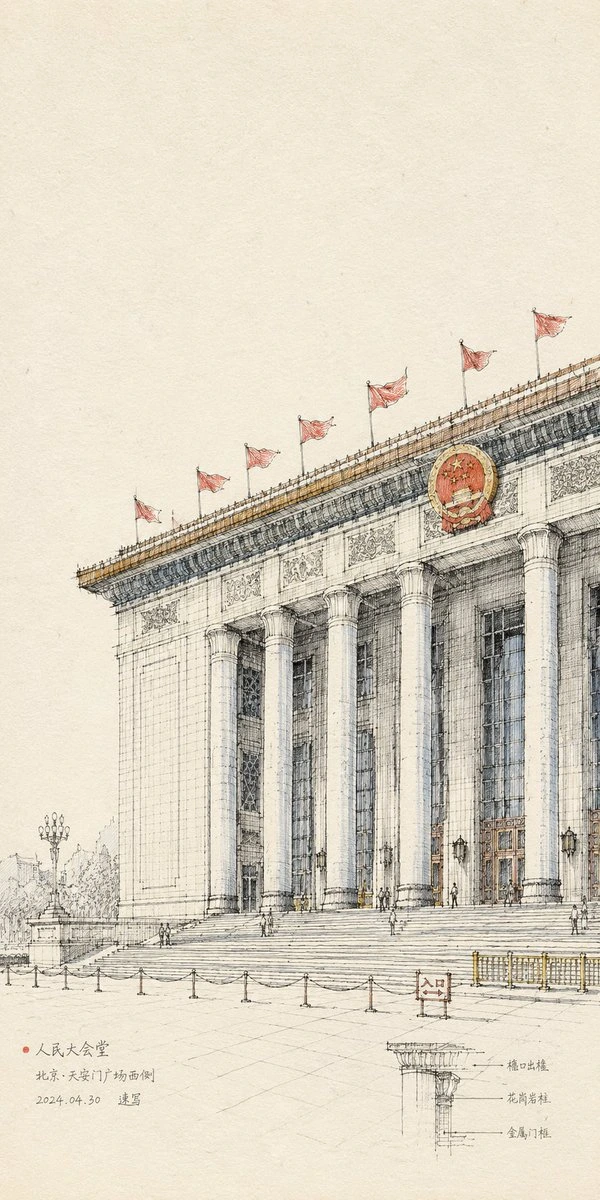
Complete AI image prompt
Reconstruct the subject through the combined discipline of an architectural survey drawing and an observant travel sketch. Establish one commanding, believable silhouette, then describe structure, terrain, and material with fine pen contours, short parallel hatching, restrained crosshatching, and selectively broken lines. Concentrate darker, tighter marks around the recognition center; let strokes grow thinner, lighter, and more widely spaced as forms recede into untouched paper. Build the composition around a compact narrative field surrounded by a much larger calm expanse, using the scale jump between occupied detail and open paper as the first-read event. For ceremonial or static subject matter, organize the dominant mass on a stable axis with near symmetry, balanced by sparse asymmetric edge motifs; for subjects driven by sequence or movement, derive a road, stream, structural band, or information trace from the theme and carry it through distant, middle, and near planes in a continuous serpentine route. Create depth through overlap, scale diminution, compressed distant line density, and dissolving contours. Use tiny people, plants, objects, or components only as occasional scale measures, decisively subordinate to the main mass. Draw on warm ivory natural paper whose fine fibers and rare pale inclusions remain visible only in exposed areas, while inked structures stay clear and transparent. Keep graphite gray, dilute black, and paper white dominant; reserve a very thin cool cyan-blue watercolor wash for the theme's flowing, glazed, shadowed, or directional layer, and place minute vermilion or ochre-red notes at symbolic joints, identifying components, route nodes, or annotation dots. Let color remain subordinate to line while creating a precise navigational rhythm. Use even natural daylight and model volume through mark density, preserving paper white as highlight. When information serves the theme, add a sparse field-note layer of title, date, scale, coordinates, direction arrows, sectional details, or leader notes in small, loosely spaced handwriting along open margins; keep orthographic anatomy valid in the chosen writing system, allow only the title a modest scale increase, and make every note a quiet knowledge cue rather than a competing focal mass. The finished image should feel serene, delicate, exacting, and unmistakably observed by hand.
Original style prompt
Reconstruct the subject through the combined discipline of an architectural survey drawing and an observant travel sketch. Establish one commanding, believable silhouette, then describe structure, terrain, and material with fine pen contours, short parallel hatching, restrained crosshatching, and selectively broken lines. Concentrate darker, tighter marks around the recognition center; let strokes grow thinner, lighter, and more widely spaced as forms recede into untouched paper. Build the composition around a compact narrative field surrounded by a much larger calm expanse, using the scale jump between occupied detail and open paper as the first-read event. For ceremonial or static subject matter, organize the dominant mass on a stable axis with near symmetry, balanced by sparse asymmetric edge motifs; for subjects driven by sequence or movement, derive a road, stream, structural band, or information trace from the theme and carry it through distant, middle, and near planes in a continuous serpentine route. Create depth through overlap, scale diminution, compressed distant line density, and dissolving contours. Use tiny people, plants, objects, or components only as occasional scale measures, decisively subordinate to the main mass. Draw on warm ivory natural paper whose fine fibers and rare pale inclusions remain visible only in exposed areas, while inked structures stay clear and transparent. Keep graphite gray, dilute black, and paper white dominant; reserve a very thin cool cyan-blue watercolor wash for the theme's flowing, glazed, shadowed, or directional layer, and place minute vermilion or ochre-red notes at symbolic joints, identifying components, route nodes, or annotation dots. Let color remain subordinate to line while creating a precise navigational rhythm. Use even natural daylight and model volume through mark density, preserving paper white as highlight. When information serves the theme, add a sparse field-note layer of title, date, scale, coordinates, direction arrows, sectional details, or leader notes in small, loosely spaced handwriting along open margins; keep orthographic anatomy valid in the chosen writing system, allow only the title a modest scale increase, and make every note a quiet knowledge cue rather than a competing focal mass. The finished image should feel serene, delicate, exacting, and unmistakably observed by hand.
More open images in the “Illustration & Visual Styles · Line Art · Paper Texture · 021” style