

Open prompts
sample 04 AI Image Prompt
sample 04, its complete AI image prompt, and the Photo Restyling · Paper Sculpture · Impasto · 197 style are free to view and copy.
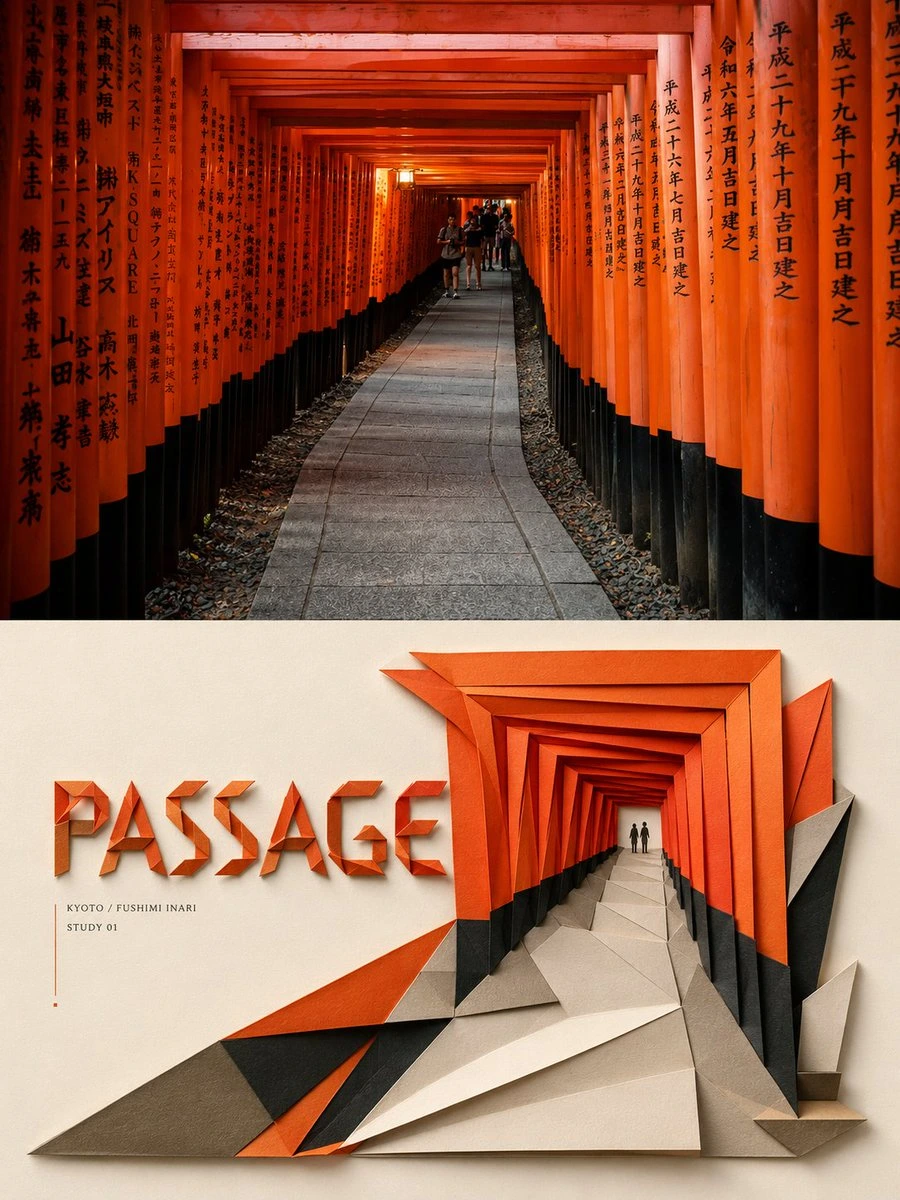
Complete AI image prompt
Build the image around a crisp horizontal division that turns one subject into a paired visual event: a credible real-world scene and its authored graphic recoding. The first field is specific, dimensional photography, preserving the subject’s most recognizable moment, the relationships among figures or objects, environmental scale, natural lighting, and legible depth. The second field extracts the same scene’s silhouette, perspective axis, repeated rhythm, hierarchy of masses, and decisive action, then reconstructs them on a warm ivory paper field as a distilled editorial image. The eye should encounter lived reality first and then recognize the same meaning compressed into a new visual syntax. Give the two fields comparable weight and bind them through a shared axis, echoed contour, or repeated gesture so continuity survives the division; in the graphic field, protect generous breathing room around one dominant thematic form, use sparse marginal information as a distant counterweight, and allow one controlled element to break the implied grid. Let the subject’s material associations select one principal making language from a bounded family: folded colored paper and shallow relief built with triangular facets, scored folds, layered edges, and soft contact shadows; flat illustration built from unoutlined color shapes, decisive silhouettes, few depth levels, and compressed perspective; or a localized impasto collage in which a miniature reconstruction is embedded inside one tactile swath of palette-knife pigment whose edges taper back into an otherwise even paper field. Use only one of these material logics as the lead treatment, while the photographic and recoded fields retain the same compositional skeleton, directional action, and relational palette. Derive color from the subject itself: one dominant family, one dark structural value, and one concentrated accent, distributed as broad restrained fields, stable dark anchors, and small high-chroma signals. Light creates atmosphere and depth in the photographic field, then reappears below as planar value separation, fold shadow, or physical pigment thickness. Treat lettering as editorial notation rather than promotional copy: one concise thematic title with a few numbers, place notes, observations, or chapter marks; create a strong scale jump between title and metadata, maintain valid anatomy for the chosen writing system, and use open tracking, fine rules, narrow text columns, and optical edge alignment to produce a quiet reading rhythm. When emphasis is needed, the title may be folded, cut, or given relief in the subject-derived material while remaining immediately readable. The finished system combines the order of a archival editorial plate with precise contemporary reduction: an evenly toned warm paper ground, solid flat ink, crisp contours, and physically credible thickness, folds, edges, and cast shadows. The photograph and abstraction must function as mutual evidence, retaining the subject’s emotional temperature while reducing its identity to an unmistakable symbolic system.


——————
Create one standalone premium poster per uploaded photo; no collages. Use a 3:4 vertical canvas split into two equal 50% halves. Upper half: retain the original photograph’s subject structure, spatial relationships, real materials, natural light and shadow, and color atmosphere, with only subtle art-magazine, independent-publication, or exhibition-grade color grading. Extend the environment naturally if needed, but never stretch, distort, or alter the subject. Lower half: on a clean ivory background, extract the most recognizable subject, silhouette, pose, and narrative relationships and reduce them through deconstruction, selection, refinement, and reconstruction into a minimal abstract composition. Preserve distinctive volume ratios, axes, curves, intersections, layering, occlusion, negative space, and asymmetry with only a few geometric forms. Keep the source instantly recognizable without copying every detail. Emphasize center of gravity, scale contrast, hierarchy, positive/negative shape, and paced whitespace; avoid icons, evenly spaced layouts, or fragment piles. Derive a restrained palette from the upper photo: one dominant color, one dark structural color, one light or neutral color, and at most a tiny key accent. Preserve its most recognizable, energetic hues; build hierarchy through area, value, and local contrast. Keep colors clean, controlled, and alive, never uniformly gray or evenly distributed. Build a complete editorial micro-typography system: a poetic 2–5-word English title derived from light, space, action, material, or emotion, plus 2–4 groups of tiny secondary copy chosen from short phrases, status words, location or subject data, numbering, chapter marks, serials, scale-like numbers, directions, material terms, archival labels, or micro-annotations. Use no years. Let the title carry emotion and the small copy provide order and detail, like an art book, architecture journal, or exhibition catalogue. Compose type with the geometry: follow axes, edges, contours, or negative space; set it vertically, rotate it, divide it into columns, open tracking, hug edges or corners, cross color fields, nest between forms, and interlock or align with the subject. Contrast one extremely small group with one slightly larger group to guide reading. Pair restrained serif type with thin editorial type. Combine real photography, abstract memory, and editorial typography in a modern, quiet, precise, collectible art object; avoid complex collage, cheap decoration, commercial templates, and meaningless abstraction.
Original style prompt
Build the image around a crisp horizontal division that turns one subject into a paired visual event: a credible real-world scene and its authored graphic recoding. The first field is specific, dimensional photography, preserving the subject’s most recognizable moment, the relationships among figures or objects, environmental scale, natural lighting, and legible depth. The second field extracts the same scene’s silhouette, perspective axis, repeated rhythm, hierarchy of masses, and decisive action, then reconstructs them on a warm ivory paper field as a distilled editorial image. The eye should encounter lived reality first and then recognize the same meaning compressed into a new visual syntax. Give the two fields comparable weight and bind them through a shared axis, echoed contour, or repeated gesture so continuity survives the division; in the graphic field, protect generous breathing room around one dominant thematic form, use sparse marginal information as a distant counterweight, and allow one controlled element to break the implied grid. Let the subject’s material associations select one principal making language from a bounded family: folded colored paper and shallow relief built with triangular facets, scored folds, layered edges, and soft contact shadows; flat illustration built from unoutlined color shapes, decisive silhouettes, few depth levels, and compressed perspective; or a localized impasto collage in which a miniature reconstruction is embedded inside one tactile swath of palette-knife pigment whose edges taper back into an otherwise even paper field. Use only one of these material logics as the lead treatment, while the photographic and recoded fields retain the same compositional skeleton, directional action, and relational palette. Derive color from the subject itself: one dominant family, one dark structural value, and one concentrated accent, distributed as broad restrained fields, stable dark anchors, and small high-chroma signals. Light creates atmosphere and depth in the photographic field, then reappears below as planar value separation, fold shadow, or physical pigment thickness. Treat lettering as editorial notation rather than promotional copy: one concise thematic title with a few numbers, place notes, observations, or chapter marks; create a strong scale jump between title and metadata, maintain valid anatomy for the chosen writing system, and use open tracking, fine rules, narrow text columns, and optical edge alignment to produce a quiet reading rhythm. When emphasis is needed, the title may be folded, cut, or given relief in the subject-derived material while remaining immediately readable. The finished system combines the order of a archival editorial plate with precise contemporary reduction: an evenly toned warm paper ground, solid flat ink, crisp contours, and physically credible thickness, folds, edges, and cast shadows. The photograph and abstraction must function as mutual evidence, retaining the subject’s emotional temperature while reducing its identity to an unmistakable symbolic system.
More open images in the “Photo Restyling · Paper Sculpture · Impasto · 197” style