

Open prompts
sample 04 AI Image Prompt
sample 04, its complete AI image prompt, and the Photo Restyling · Solar Terms · Printmaking · 201 style are free to view and copy.
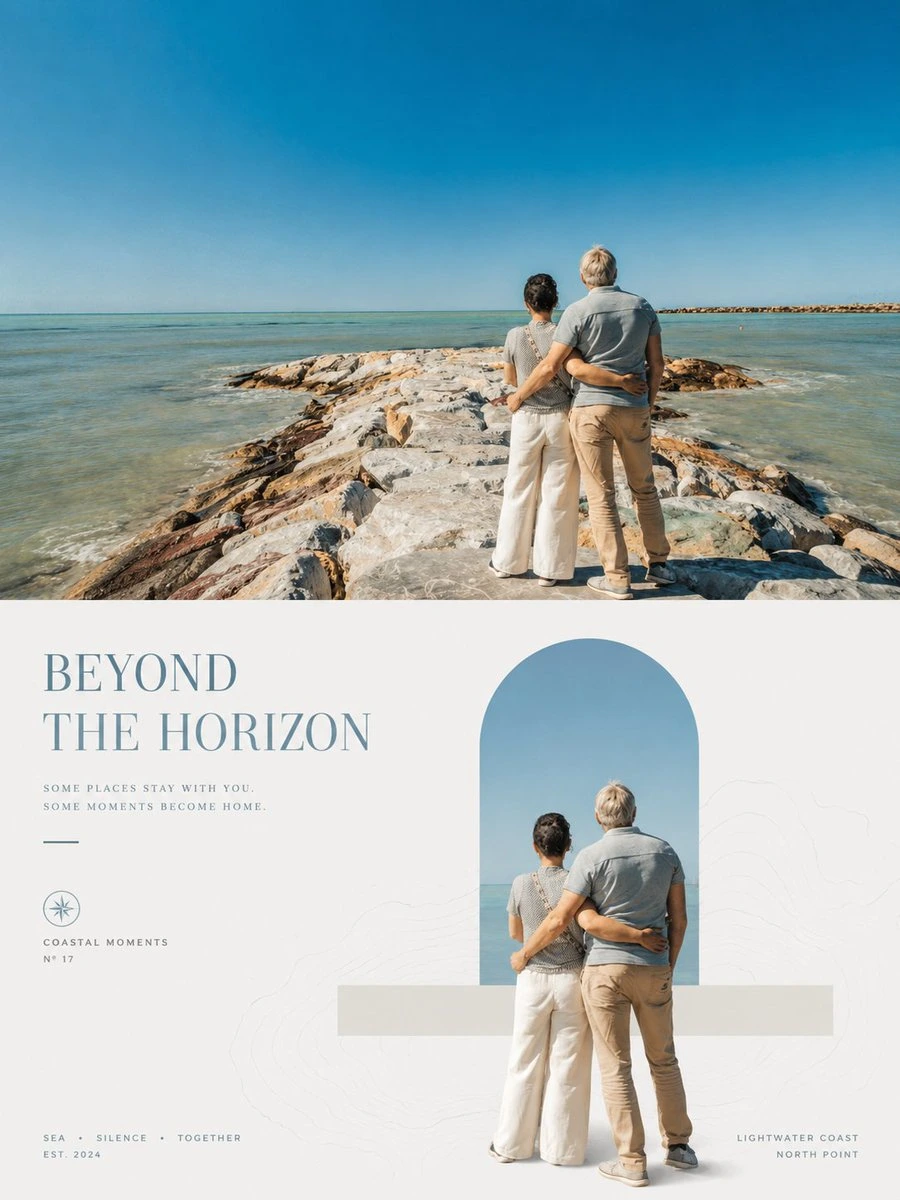
Complete AI image prompt
Build a two-stage apparition of the same subject, where a full-bleed documentary scene meets a warm paper-white field across one decisive horizontal break: the photographic realm carries roughly half the visual weight and establishes lived time and place through natural environmental light, credible depth, unposed relationships, and the subject’s most recognizable moment; the graphic realm recasts the scene’s defining contour, route, terrain, object, or gesture as a dominant aperture, silhouette vessel, or oblique band. Insert theme-derived photographic fragments into that shape, let one important fragment cross its boundary, or reduce the imagery to a two- or three-ink flat form, creating a symbolic memory of the scene rather than a duplicate. Govern the space with an asymmetrical editorial grid and dynamic equilibrium: one highly legible main form owns about two thirds of the graphic weight, while generous emptiness and the headline counterbalance it across distance and minor information retreats to the margins. Lead the eye from lived scene, across the break, into the enlarged, cropped, or hollowed subject contour, then out through sparse annotations. Allow the aperture to mutate with the subject into a tall rectangle, rounded arch, broad diagonal, thematic silhouette, or hand-edged color shape, while preserving one controlled overstep, figure-ground exchange, and enough interrupted contour for the viewer to complete the form. Keep the surrounding field predominantly empty, carrying only very pale, low-contrast traces derived from the theme—topographic paths, botanical contours, ripples, or structural trajectories. Draw the palette from the scene: retain restrained natural color and clear value structure in the documentary image, then condense it into warm paper white, one muted structural hue, one soft companion hue, and a very small warm marker in the graphic field; bind both realms through a repeated contour or shared hue. Set the headline in a light high-contrast serif or restrained humanist sans, preserving valid glyph anatomy for the chosen writing system, with airy spacing and two or three measured lines when content requires it. Use very small widely tracked captions, short rules, dots, numbering, and coordinate-like intervals as archival rhythm; all wording and information hierarchy come from the subject. Let the transformed image range in a controlled way between crisp full-color photographic collage with preserved illumination and a flat screen-printed silhouette whose paper absorption creates gently irregular ink edges and localized density shifts; confine this material behavior to the printed color layers while the broad paper field remains even and quiet. Hold a poetic, restrained, humane travel-editorial tone in which reality and abstract memory remain simultaneously visible.
Original style prompt
Build a two-stage apparition of the same subject, where a full-bleed documentary scene meets a warm paper-white field across one decisive horizontal break: the photographic realm carries roughly half the visual weight and establishes lived time and place through natural environmental light, credible depth, unposed relationships, and the subject’s most recognizable moment; the graphic realm recasts the scene’s defining contour, route, terrain, object, or gesture as a dominant aperture, silhouette vessel, or oblique band. Insert theme-derived photographic fragments into that shape, let one important fragment cross its boundary, or reduce the imagery to a two- or three-ink flat form, creating a symbolic memory of the scene rather than a duplicate. Govern the space with an asymmetrical editorial grid and dynamic equilibrium: one highly legible main form owns about two thirds of the graphic weight, while generous emptiness and the headline counterbalance it across distance and minor information retreats to the margins. Lead the eye from lived scene, across the break, into the enlarged, cropped, or hollowed subject contour, then out through sparse annotations. Allow the aperture to mutate with the subject into a tall rectangle, rounded arch, broad diagonal, thematic silhouette, or hand-edged color shape, while preserving one controlled overstep, figure-ground exchange, and enough interrupted contour for the viewer to complete the form. Keep the surrounding field predominantly empty, carrying only very pale, low-contrast traces derived from the theme—topographic paths, botanical contours, ripples, or structural trajectories. Draw the palette from the scene: retain restrained natural color and clear value structure in the documentary image, then condense it into warm paper white, one muted structural hue, one soft companion hue, and a very small warm marker in the graphic field; bind both realms through a repeated contour or shared hue. Set the headline in a light high-contrast serif or restrained humanist sans, preserving valid glyph anatomy for the chosen writing system, with airy spacing and two or three measured lines when content requires it. Use very small widely tracked captions, short rules, dots, numbering, and coordinate-like intervals as archival rhythm; all wording and information hierarchy come from the subject. Let the transformed image range in a controlled way between crisp full-color photographic collage with preserved illumination and a flat screen-printed silhouette whose paper absorption creates gently irregular ink edges and localized density shifts; confine this material behavior to the printed color layers while the broad paper field remains even and quiet. Hold a poetic, restrained, humane travel-editorial tone in which reality and abstract memory remain simultaneously visible.
More open images in the “Photo Restyling · Solar Terms · Printmaking · 201” style