

Open prompts
sample 04 AI Image Prompt
sample 04, its complete AI image prompt, and the Infographics & Visual Guides · 3D · Foam · 130 style are free to view and copy.
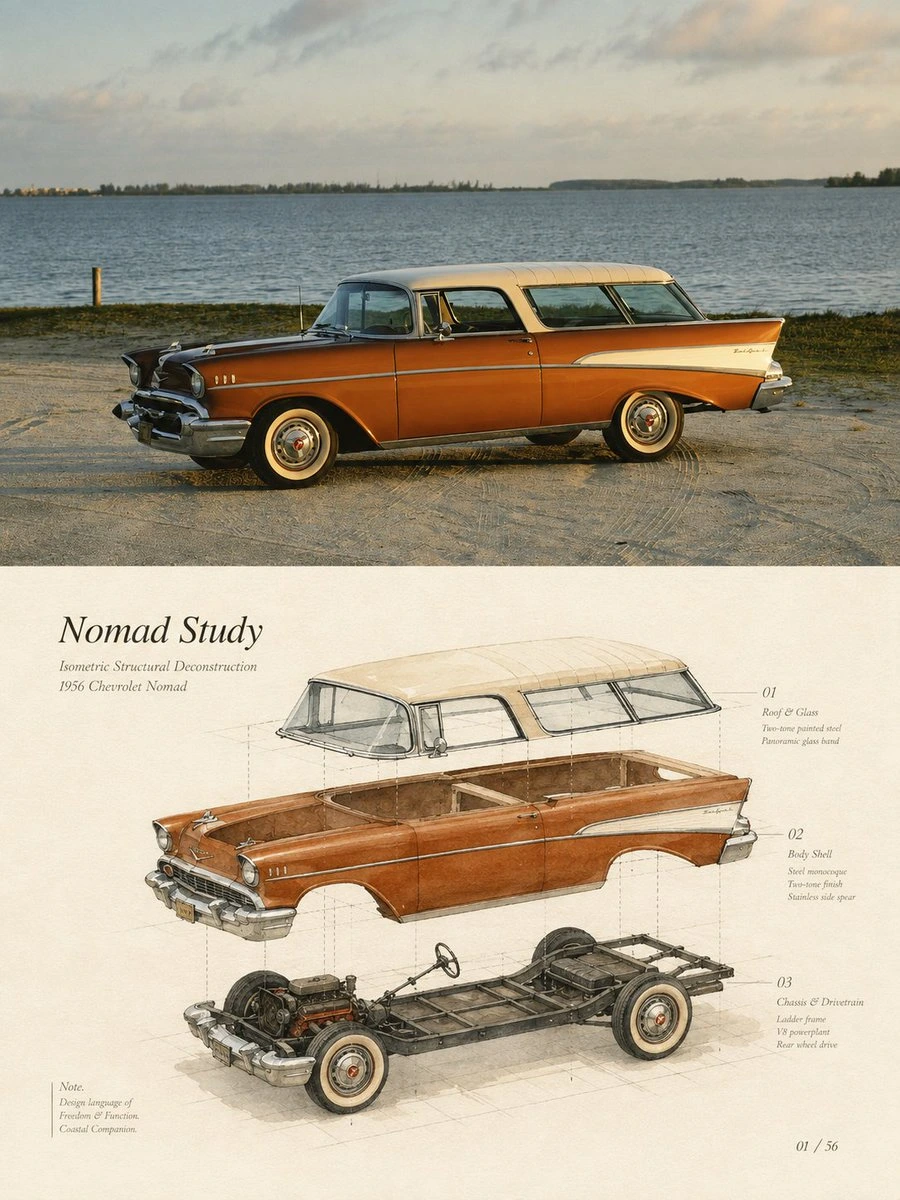
Complete AI image prompt
Stage the subject as a two-state translation whose first read moves from presence to understanding. Build the opening visual field as restrained, credible photography: give the subject the clearest recognition and let its real environment contribute only scale, location, function, atmosphere, natural time-of-day light, aerial depth, and truthful material reflections. Follow it with a sharply separated interpretive field that reconstructs the same subject as a study artifact. Preserve its identifying contour, key proportions, and structural landmarks, then let the subject’s own logic determine whether the reconstruction becomes an axonometric assembly, exploded hierarchy, sectional model, component sequence, or a congruent silhouette condensed from a materially relevant substance. Balance the photographic and interpretive fields at roughly equal visual weight with a firm, clean division; guide the eye from the real whole to one oversized reconstructed centerpiece, then outward through numbered leaders, detail studies, scale marks, samples, and peripheral notes. Keep auxiliary views small and marginal, with ample open space and a calm archival rhythm. For analytical reconstructions, use precise fine lines, pale watercolor washes, translucent construction layers, and short contact shadows; separate parts along plausible assembly paths while retaining exact alignment. Translate organic or environmental subjects through cutaway masses, contour lines, sectional traces, and material specimens that reveal how the form came into being. Let the photographic palette arise from place and subject, then compress those hues below into paper white, limestone, graphite gray, faint washes, and one subject-derived accent. As a bounded alternative, reduce the photograph’s dominant hue to a deep matte field and draw the matching silhouette with translucent droplets, liquid highlights, and moist coalescing edges, allowing the droplets to disperse only around the figure. Set the main title in a high-contrast serif with generous tracking; subordinate identity, place, and time in quiet short lines. Use small upright technical lettering for theme-derived facts, joined to hairline leaders, circled numerals, coordinates, scale bars, compact swatches, and sparse handwritten observations. Keep the analytical field like even warm cotton drawing paper with delicate pigment absorption, lucid linework, and undimmed open areas; keep the liquid variant as a continuous finely matte wet surface. The whole system should feel like a photographic monograph fused with an architectural field archive—quiet, exact, rational, and poetic through correspondence—always preserving the sequence of first seeing the subject exist and then discovering how it is constructed, with matched silhouettes, stable two-field balance, and information density diminishing from the central reconstruction toward the edges.
Original style prompt
Stage the subject as a two-state translation whose first read moves from presence to understanding. Build the opening visual field as restrained, credible photography: give the subject the clearest recognition and let its real environment contribute only scale, location, function, atmosphere, natural time-of-day light, aerial depth, and truthful material reflections. Follow it with a sharply separated interpretive field that reconstructs the same subject as a study artifact. Preserve its identifying contour, key proportions, and structural landmarks, then let the subject’s own logic determine whether the reconstruction becomes an axonometric assembly, exploded hierarchy, sectional model, component sequence, or a congruent silhouette condensed from a materially relevant substance. Balance the photographic and interpretive fields at roughly equal visual weight with a firm, clean division; guide the eye from the real whole to one oversized reconstructed centerpiece, then outward through numbered leaders, detail studies, scale marks, samples, and peripheral notes. Keep auxiliary views small and marginal, with ample open space and a calm archival rhythm. For analytical reconstructions, use precise fine lines, pale watercolor washes, translucent construction layers, and short contact shadows; separate parts along plausible assembly paths while retaining exact alignment. Translate organic or environmental subjects through cutaway masses, contour lines, sectional traces, and material specimens that reveal how the form came into being. Let the photographic palette arise from place and subject, then compress those hues below into paper white, limestone, graphite gray, faint washes, and one subject-derived accent. As a bounded alternative, reduce the photograph’s dominant hue to a deep matte field and draw the matching silhouette with translucent droplets, liquid highlights, and moist coalescing edges, allowing the droplets to disperse only around the figure. Set the main title in a high-contrast serif with generous tracking; subordinate identity, place, and time in quiet short lines. Use small upright technical lettering for theme-derived facts, joined to hairline leaders, circled numerals, coordinates, scale bars, compact swatches, and sparse handwritten observations. Keep the analytical field like even warm cotton drawing paper with delicate pigment absorption, lucid linework, and undimmed open areas; keep the liquid variant as a continuous finely matte wet surface. The whole system should feel like a photographic monograph fused with an architectural field archive—quiet, exact, rational, and poetic through correspondence—always preserving the sequence of first seeing the subject exist and then discovering how it is constructed, with matched silhouettes, stable two-field balance, and information density diminishing from the central reconstruction toward the edges.
More open images in the “Infographics & Visual Guides · 3D · Foam · 130” style