

Open prompts
sample 04 AI Image Prompt
sample 04, its complete AI image prompt, and the Travel, Cities & Architecture · X Archive · 071 style are free to view and copy.
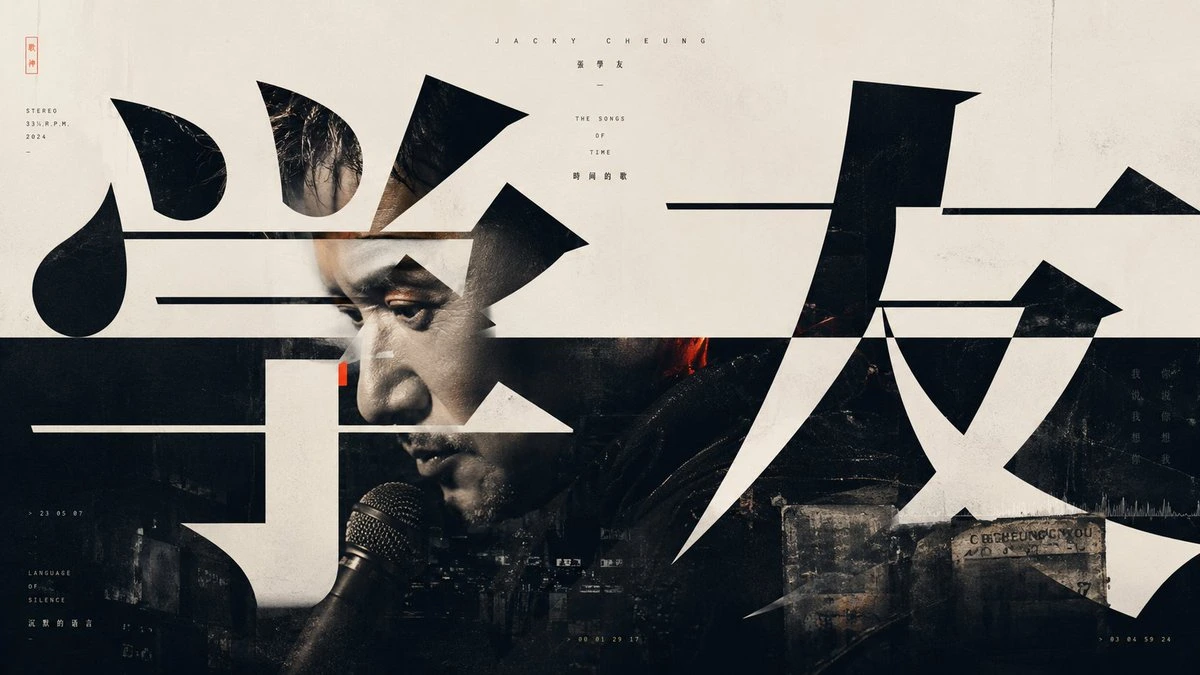
Complete AI image prompt
Build the first read around monumental custom lettering that functions simultaneously as title, compositional armature, photographic mask, and figure-ground switch. Redraw the main words from the valid topology of the intended writing system: keep every glyph recognizable through its structural components, stroke direction, counters, joins, and orthographic rhythm, while extending decisive horizontal strokes across long distances and cutting selected turns into sharp wedges, curved blade-like lobes, and suspended fragments. Gaps should still resolve through alignment, continuity, and perceptual closure. Balance a broad warm off-white paper field against a heavy charcoal field in an almost even but dynamically unequal split, crossed by one thin, assertive horizontal axis. Let the giant glyphs breach that division, press into the frame, and accept selective cropping; generous emptiness establishes their monumental scale, while tiny marginal information acts as a distant counterweight. Guide the eye along an extended stroke, arrest it where imagery meets the light-dark boundary, then release it through an acute terminal. Derive semantic form, symbolic cues, people or environmental traces, material associations, and emotional temperature from the chosen subject. Break its defining photograph or realistic scene into a small number of coherent slices and reveal them only inside selected strokes, counters, and dark collage planes. Make a single stroke alternate between solid black on paper white, paper-white reversal across the dark field, and a window into the subject image. A key subject may be occluded by the glyph yet remain legible when adjacent slices reconnect; lettering and image must generate one another rather than sit in separate layers. Establish the value system with bone white, smoke gray, and near-black charcoal. Allow the subject to contribute only restrained, low-chroma local color inside image windows, preserving its plausible skin, sky, or material temperature, with a very small vermilion seal or hairline accent as a punctuating beat. Concentrate light at the thematic focus and the field transition while retaining readable depth in the blacks. Use an even matte fibrous paper base; construct the dark zone as shallow overlapping planes of photographic shadow, manuscript traces, handwriting, and geometric paper pieces, without elaborate perspective. Keep the pale field spacious, carrying only sparse dates, serial marks, coordinate-like notes, and fine rules. Confine physical print erosion to the dense charcoal collage and heavy display ink: uneven absorption gives limited broken edges and localized rubbing exposes paper fiber, while the focal image, open pale field, and microtype remain crisp and intact. Set supporting text extremely small, widely tracked, short-lined, and quietly columnar, creating an extreme density jump against the display glyphs; square seal-like marks and technical annotations serve only as rhythmic pins. The result should feel restrained, dramatic, and archival, with every fragment, surface event, and information mark subordinated to the cross-boundary fusion of giant lettering, image, and light-dark space.
Original style prompt
Build the first read around monumental custom lettering that functions simultaneously as title, compositional armature, photographic mask, and figure-ground switch. Redraw the main words from the valid topology of the intended writing system: keep every glyph recognizable through its structural components, stroke direction, counters, joins, and orthographic rhythm, while extending decisive horizontal strokes across long distances and cutting selected turns into sharp wedges, curved blade-like lobes, and suspended fragments. Gaps should still resolve through alignment, continuity, and perceptual closure. Balance a broad warm off-white paper field against a heavy charcoal field in an almost even but dynamically unequal split, crossed by one thin, assertive horizontal axis. Let the giant glyphs breach that division, press into the frame, and accept selective cropping; generous emptiness establishes their monumental scale, while tiny marginal information acts as a distant counterweight. Guide the eye along an extended stroke, arrest it where imagery meets the light-dark boundary, then release it through an acute terminal. Derive semantic form, symbolic cues, people or environmental traces, material associations, and emotional temperature from the chosen subject. Break its defining photograph or realistic scene into a small number of coherent slices and reveal them only inside selected strokes, counters, and dark collage planes. Make a single stroke alternate between solid black on paper white, paper-white reversal across the dark field, and a window into the subject image. A key subject may be occluded by the glyph yet remain legible when adjacent slices reconnect; lettering and image must generate one another rather than sit in separate layers. Establish the value system with bone white, smoke gray, and near-black charcoal. Allow the subject to contribute only restrained, low-chroma local color inside image windows, preserving its plausible skin, sky, or material temperature, with a very small vermilion seal or hairline accent as a punctuating beat. Concentrate light at the thematic focus and the field transition while retaining readable depth in the blacks. Use an even matte fibrous paper base; construct the dark zone as shallow overlapping planes of photographic shadow, manuscript traces, handwriting, and geometric paper pieces, without elaborate perspective. Keep the pale field spacious, carrying only sparse dates, serial marks, coordinate-like notes, and fine rules. Confine physical print erosion to the dense charcoal collage and heavy display ink: uneven absorption gives limited broken edges and localized rubbing exposes paper fiber, while the focal image, open pale field, and microtype remain crisp and intact. Set supporting text extremely small, widely tracked, short-lined, and quietly columnar, creating an extreme density jump against the display glyphs; square seal-like marks and technical annotations serve only as rhythmic pins. The result should feel restrained, dramatic, and archival, with every fragment, surface event, and information mark subordinated to the cross-boundary fusion of giant lettering, image, and light-dark space.
More open images in the “Travel, Cities & Architecture · X Archive · 071” style