

Open prompts
sample 05 AI Image Prompt
sample 05, its complete AI image prompt, and the Avatars, Stickers & Play · Watercolor · Line Art · 127 style are free to view and copy.
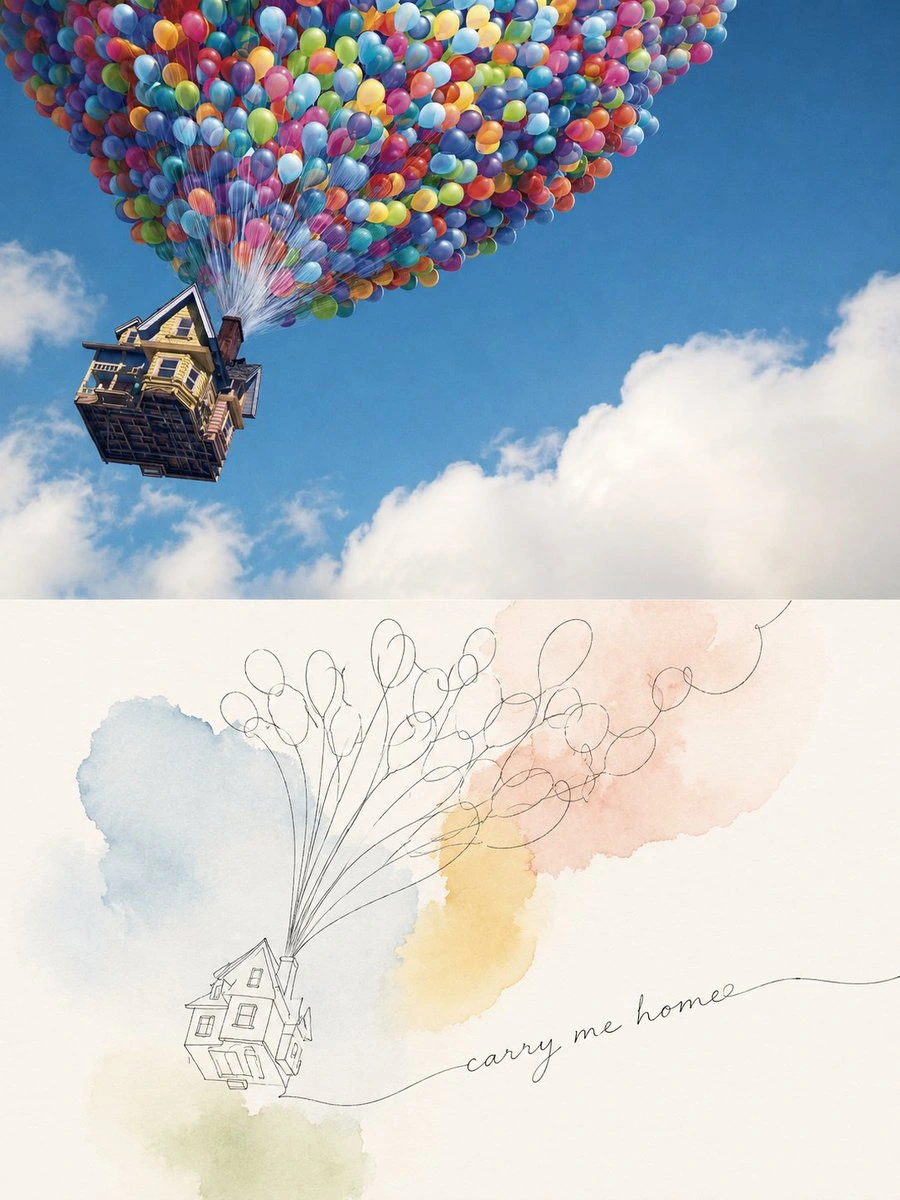
Complete AI image prompt
Build the first read around a clean horizontal split: the upper field is a full-bleed photographic world with believable space, light, atmosphere, and narrative, while the lower field immediately reconstructs the same visual event as a deliberately materialized surrogate. Keep the two fields close in visual weight and preserve identity relationships, pose direction, scale hierarchy, and the decisive instant across the divide. Let the photograph crop naturally and carry real depth; in the reconstruction, remove incidental surroundings and retain the most recognizable silhouette, facial or structural nodes, gesture, attachments, negative shapes, and environmental path, resolving the form more completely so the eye closes a clear reality-to-remaking loop. Let the subject determine the lower medium. When meaning resides in volume, structure, and object relationships, rebuild it as a genuinely photographable modular miniature: visible interlocking units, stepped contours, sparing curved parts, coherent seams and assembly logic, firm contact shadows, and a reduced setting that establishes scale. When meaning resides in emotion, gesture, or a trail of light, compress the same relationship into contour-led printed or hand-drawn imagery, using restrained flat ink, translucent color fields, and open paper to carry atmosphere. In either realization, keep topology and key negative spaces legible and make the medium serve the subject. Derive the lower palette from the upper image by preserving value order, dominant color roles, and a few small high-chroma anchors while reducing complex illumination to a limited set of material colors or transparent washes. The photograph’s light direction and emotional temperature govern the reconstruction: dimensional pieces receive soft studio modeling, while planar work sits on an even warm-white paper field with lucid lines and controlled color layers. Treat information as a quiet archival annotation in the lower field: one brief heading or index plus one or two lines of theme-derived keywords, set as a narrow side note in monospaced typewriter-like lettering or a squared glyph skeleton related to the modular units, with airy tracking, a decisive scale jump, and generous silence between copy and image. Use one dominant form to outweigh all other masses; let the annotation retreat toward an edge as a light counterbalance. Both fields share the same entry point, directional axis, and visual pause, while the lower field introduces one controlled departure through material reduction, a slight local displacement, and purposeful emptiness, combining photographic credibility, collectible archival order, and the intimate evidence of hand-built translation.
Original style prompt
Build the first read around a clean horizontal split: the upper field is a full-bleed photographic world with believable space, light, atmosphere, and narrative, while the lower field immediately reconstructs the same visual event as a deliberately materialized surrogate. Keep the two fields close in visual weight and preserve identity relationships, pose direction, scale hierarchy, and the decisive instant across the divide. Let the photograph crop naturally and carry real depth; in the reconstruction, remove incidental surroundings and retain the most recognizable silhouette, facial or structural nodes, gesture, attachments, negative shapes, and environmental path, resolving the form more completely so the eye closes a clear reality-to-remaking loop. Let the subject determine the lower medium. When meaning resides in volume, structure, and object relationships, rebuild it as a genuinely photographable modular miniature: visible interlocking units, stepped contours, sparing curved parts, coherent seams and assembly logic, firm contact shadows, and a reduced setting that establishes scale. When meaning resides in emotion, gesture, or a trail of light, compress the same relationship into contour-led printed or hand-drawn imagery, using restrained flat ink, translucent color fields, and open paper to carry atmosphere. In either realization, keep topology and key negative spaces legible and make the medium serve the subject. Derive the lower palette from the upper image by preserving value order, dominant color roles, and a few small high-chroma anchors while reducing complex illumination to a limited set of material colors or transparent washes. The photograph’s light direction and emotional temperature govern the reconstruction: dimensional pieces receive soft studio modeling, while planar work sits on an even warm-white paper field with lucid lines and controlled color layers. Treat information as a quiet archival annotation in the lower field: one brief heading or index plus one or two lines of theme-derived keywords, set as a narrow side note in monospaced typewriter-like lettering or a squared glyph skeleton related to the modular units, with airy tracking, a decisive scale jump, and generous silence between copy and image. Use one dominant form to outweigh all other masses; let the annotation retreat toward an edge as a light counterbalance. Both fields share the same entry point, directional axis, and visual pause, while the lower field introduces one controlled departure through material reduction, a slight local displacement, and purposeful emptiness, combining photographic credibility, collectible archival order, and the intimate evidence of hand-built translation.
More open images in the “Avatars, Stickers & Play · Watercolor · Line Art · 127” style