

Open prompts
sample 05 AI Image Prompt
sample 05, its complete AI image prompt, and the Infographics & Visual Guides · Solar Terms · Paper Texture · 148 style are free to view and copy.
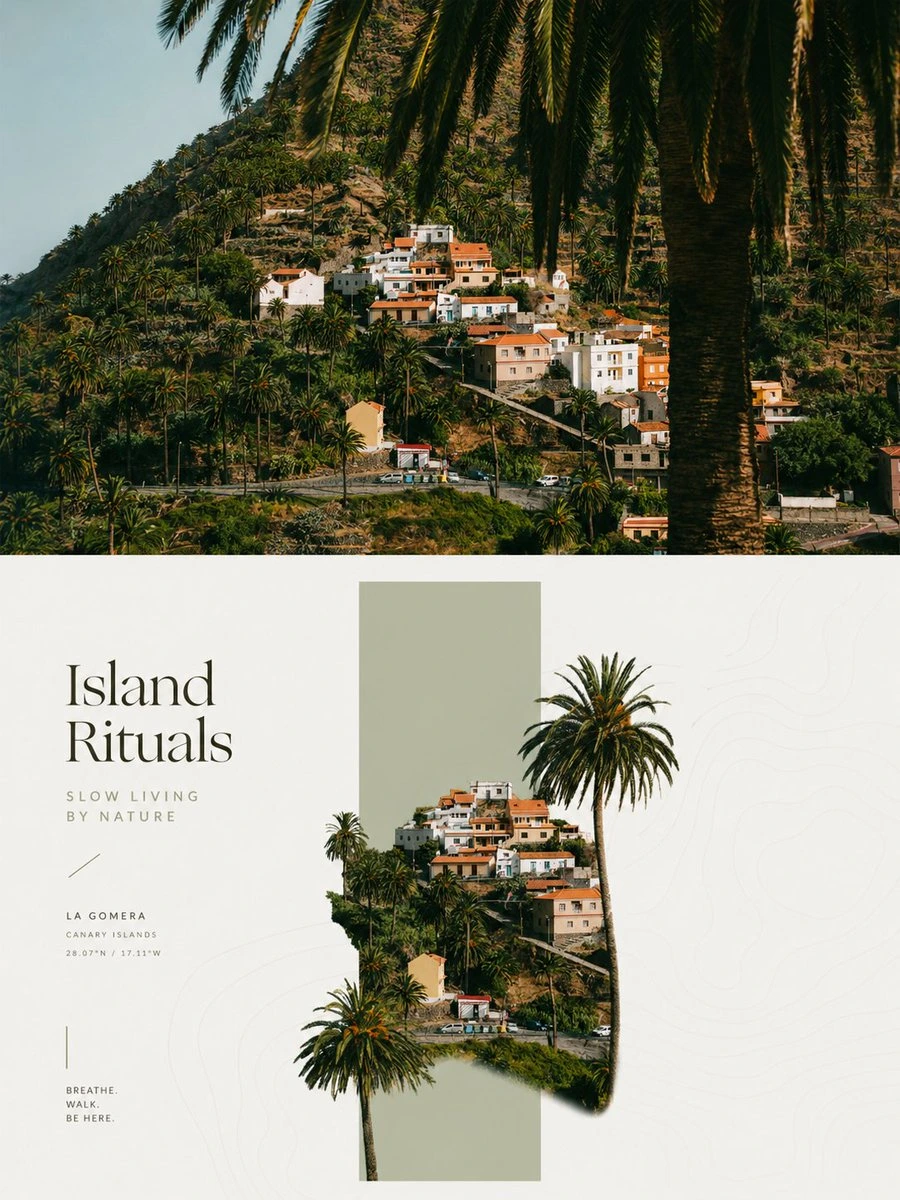
Complete AI image prompt
Build a two-stage visual event in which the same subject moves from lived reality into an editorial distillation. Let a dominant, fully resolved documentary photograph establish natural light, spatial depth, atmosphere, and emotional context, then answer it with an adjoining expanse of warm ivory paper where the most recognizable subject and environmental cue return as a restrained image-and-type composition. Balance the substantial image field against an almost equal, visually lighter information field, separated by a decisive boundary; preserve generous breathing room and use an optically off-center silhouette, sparse headline, and miniature annotations as counterweights. Guide the eye from the complete scene into a selective view or cutout, arrest it at the headline, and release it through widely spaced small text. Choose one bounded transformation according to the subject's geometry: place a softened reprise of the scene inside a circular, arched, or clipped-corner fine-line window with simple architectural fret divisions, or isolate the main carrier along its true contour and let it cross a plain vertical, horizontal, or diagonal band of pale color as a controlled break in the grid. Retain recognizable photographic detail and natural edges in both treatments; allow only secondary surroundings to recede through low opacity. Theme-derived foliage, contour lines, or soft cast shadows may enter from the paper edge to bridge image and emptiness while remaining subordinate. Derive the palette from the subject itself: use warm ivory as the largest field, reduce its supporting warm or cool midtones into frames, bands, and hairlines, reserve the clearest local color for the focal carrier, and set information in deep gray-brown or gray-blue. Keep richer contrast and crystalline color in the complete scene while the editorial field stays high-key, low-contrast, and airy, linking both layers through shared hues. Set the display title in a slender high-contrast serif structure with valid anatomy for the chosen writing system, clearly larger than all other copy, arranged in two or three calm lines with open leading. Render captions, location-like metadata, numbering, and short notes at miniature scale with wide tracking, using fine rules, short dashes, a small seal, or a theme-derived micro-symbol as pauses; let the subject determine every information role and wording. Finish with an even matte paper field, flat translucent color shapes, crisp photographic resolution, and gently softened editorial edges so photography, geometric framing, precise cutout, open paper, and quiet typography read as one contemporary editorial-book language.
Original style prompt
Build a two-stage visual event in which the same subject moves from lived reality into an editorial distillation. Let a dominant, fully resolved documentary photograph establish natural light, spatial depth, atmosphere, and emotional context, then answer it with an adjoining expanse of warm ivory paper where the most recognizable subject and environmental cue return as a restrained image-and-type composition. Balance the substantial image field against an almost equal, visually lighter information field, separated by a decisive boundary; preserve generous breathing room and use an optically off-center silhouette, sparse headline, and miniature annotations as counterweights. Guide the eye from the complete scene into a selective view or cutout, arrest it at the headline, and release it through widely spaced small text. Choose one bounded transformation according to the subject's geometry: place a softened reprise of the scene inside a circular, arched, or clipped-corner fine-line window with simple architectural fret divisions, or isolate the main carrier along its true contour and let it cross a plain vertical, horizontal, or diagonal band of pale color as a controlled break in the grid. Retain recognizable photographic detail and natural edges in both treatments; allow only secondary surroundings to recede through low opacity. Theme-derived foliage, contour lines, or soft cast shadows may enter from the paper edge to bridge image and emptiness while remaining subordinate. Derive the palette from the subject itself: use warm ivory as the largest field, reduce its supporting warm or cool midtones into frames, bands, and hairlines, reserve the clearest local color for the focal carrier, and set information in deep gray-brown or gray-blue. Keep richer contrast and crystalline color in the complete scene while the editorial field stays high-key, low-contrast, and airy, linking both layers through shared hues. Set the display title in a slender high-contrast serif structure with valid anatomy for the chosen writing system, clearly larger than all other copy, arranged in two or three calm lines with open leading. Render captions, location-like metadata, numbering, and short notes at miniature scale with wide tracking, using fine rules, short dashes, a small seal, or a theme-derived micro-symbol as pauses; let the subject determine every information role and wording. Finish with an even matte paper field, flat translucent color shapes, crisp photographic resolution, and gently softened editorial edges so photography, geometric framing, precise cutout, open paper, and quiet typography read as one contemporary editorial-book language.
More open images in the “Infographics & Visual Guides · Solar Terms · Paper Texture · 148” style