

Open prompts
sample 06 AI Image Prompt
sample 06, its complete AI image prompt, and the Photo Restyling · Printmaking · Impasto · 203 style are free to view and copy.
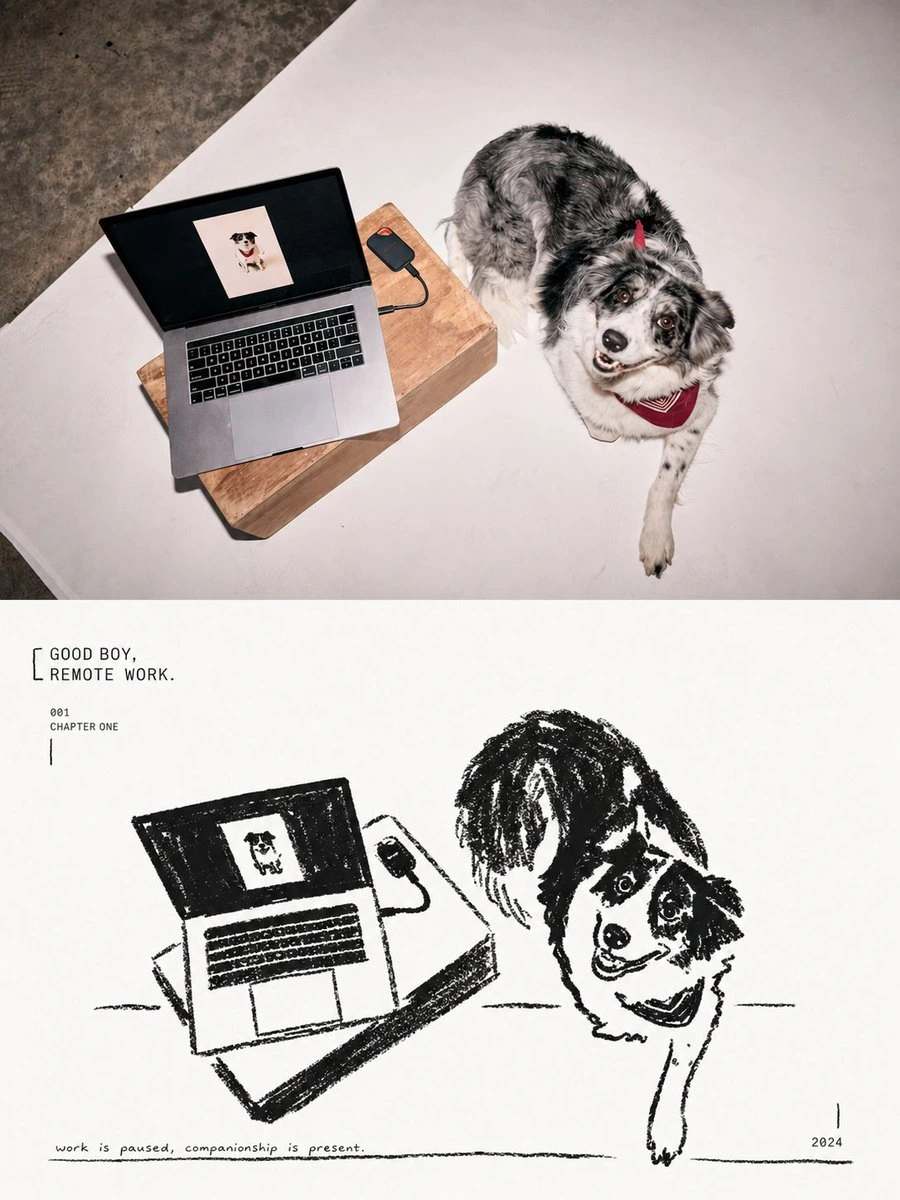
Complete AI image prompt
Stage the subject twice as one continuous act of observation: first as a color documentary scene with tangible place, perspective, scale, and emotional light, then as a reduced black-and-white paper rendering that feels like the scene has been recalled by hand. Let the subject determine the setting, symbolic form, attachments, material cues, and palette; keep the photographic field broad and low in saturation, with natural tonal depth and only a few emitted lights or compact warm accents carrying chromatic emphasis. In the paper field, preserve only the subject’s most recognizable contour, gesture, connected props, and one necessary ground or horizon cue. Render a nearby dominant form with short, resistant black crayon strokes: broken contour pressure, repeated opaque rubbing in the deepest masses, irregular stroke density, and clean paper white acting as the highlights. Translate distant forms and environmental depth into a single-color screened dot structure that shifts from dense to sparse along silhouettes and the horizon until it dissolves into open paper. Maintain a dominant-versus-quiet hierarchy: the photographic scene carries the narrative, while the paper interpretation receives the larger breathing field; use either near-axial monumentality or an asymmetrical weight balanced by remote marginal notes, but make both layers share the same visual anchor so the eye drops naturally from the witnessed object to its distilled graphic echo. Keep all information subordinate and widely separated: one brief thematic phrase, a plate number, year, coordinate-like data, or a hushed caption placed near the margins, linked by an occasional short rule, hairline vertical, or corner mark. Make lettering respond to the rendering process: blunt, loosely aligned hand lettering with changing pressure beside crayon masses; narrow geometric sans lettering with generous tracking beside screened silhouettes; use tiny monospaced or typewritten structures for metadata, preserving valid anatomy and recognition in the chosen writing system. Use warm matte paper with an even fiber body; missing ink belongs only inside the compressed black crayon marks, and the screened dots remain confined to the translated image and its dot-dissolution boundary, leaving the surrounding paper clear and luminous. The result should read like a restrained visual field note in which documentary color and handmade monochrome verify the same subject, with emotion produced by the scale shift, isolated negative space, sparse information, and the tension between lived scene and remembered silhouette.
Original style prompt
Stage the subject twice as one continuous act of observation: first as a color documentary scene with tangible place, perspective, scale, and emotional light, then as a reduced black-and-white paper rendering that feels like the scene has been recalled by hand. Let the subject determine the setting, symbolic form, attachments, material cues, and palette; keep the photographic field broad and low in saturation, with natural tonal depth and only a few emitted lights or compact warm accents carrying chromatic emphasis. In the paper field, preserve only the subject’s most recognizable contour, gesture, connected props, and one necessary ground or horizon cue. Render a nearby dominant form with short, resistant black crayon strokes: broken contour pressure, repeated opaque rubbing in the deepest masses, irregular stroke density, and clean paper white acting as the highlights. Translate distant forms and environmental depth into a single-color screened dot structure that shifts from dense to sparse along silhouettes and the horizon until it dissolves into open paper. Maintain a dominant-versus-quiet hierarchy: the photographic scene carries the narrative, while the paper interpretation receives the larger breathing field; use either near-axial monumentality or an asymmetrical weight balanced by remote marginal notes, but make both layers share the same visual anchor so the eye drops naturally from the witnessed object to its distilled graphic echo. Keep all information subordinate and widely separated: one brief thematic phrase, a plate number, year, coordinate-like data, or a hushed caption placed near the margins, linked by an occasional short rule, hairline vertical, or corner mark. Make lettering respond to the rendering process: blunt, loosely aligned hand lettering with changing pressure beside crayon masses; narrow geometric sans lettering with generous tracking beside screened silhouettes; use tiny monospaced or typewritten structures for metadata, preserving valid anatomy and recognition in the chosen writing system. Use warm matte paper with an even fiber body; missing ink belongs only inside the compressed black crayon marks, and the screened dots remain confined to the translated image and its dot-dissolution boundary, leaving the surrounding paper clear and luminous. The result should read like a restrained visual field note in which documentary color and handmade monochrome verify the same subject, with emotion produced by the scale shift, isolated negative space, sparse information, and the tension between lived scene and remembered silhouette.
More open images in the “Photo Restyling · Printmaking · Impasto · 203” style