

Open prompts
sample 06 AI Image Prompt
sample 06, its complete AI image prompt, and the Photo Restyling · Printmaking · Vector · 196 style are free to view and copy.
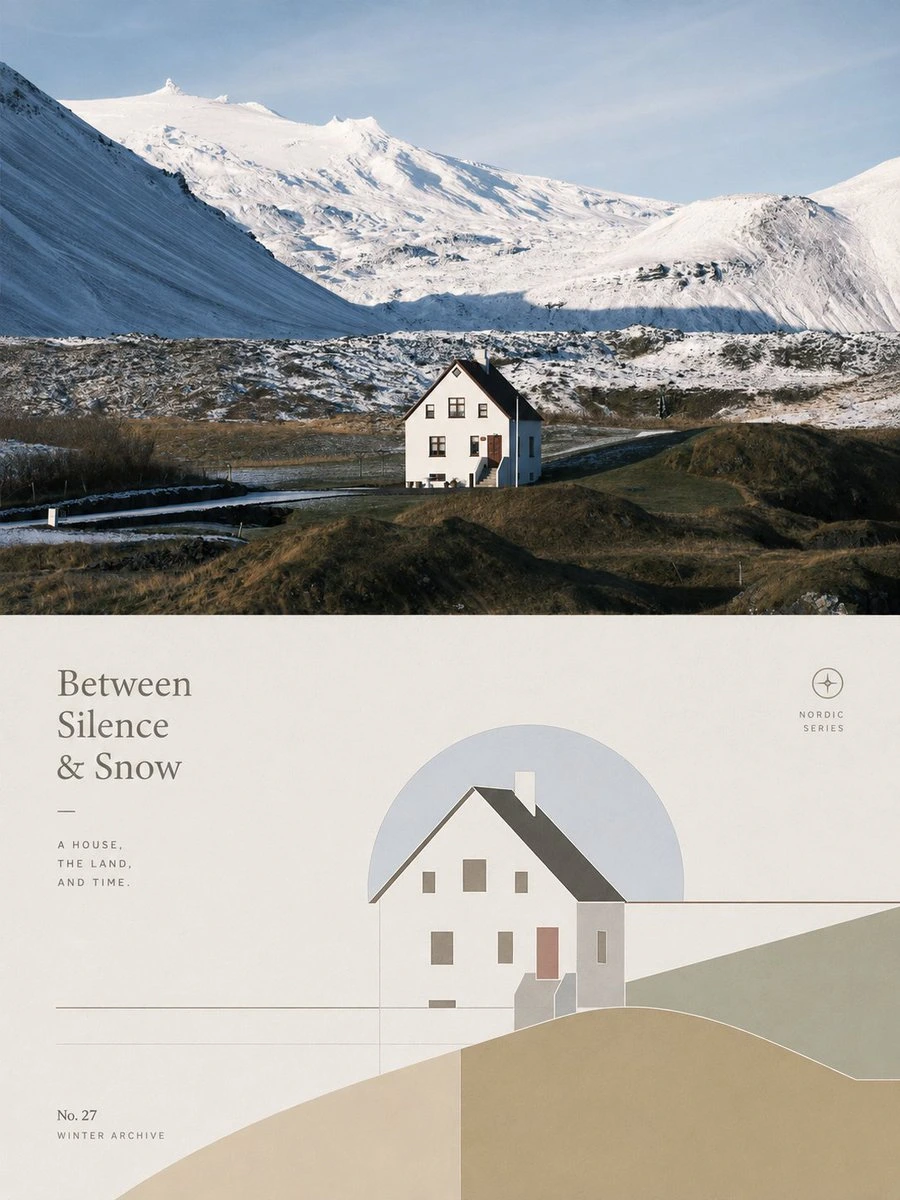
Complete AI image prompt
Build a two-stage visual reading of the same theme: first establish it as an observational, atmospheric reality, then cross a quiet, straight horizontal divide and recode its meaning as a restrained graphic memory on warm-white paper. The upper field should retain natural light, material credibility, environmental depth, scale cues, and an unforced gesture; the lower field should extract the theme's most recognizable contour, structural skeleton, directional arc, or object relationship and condense it through silhouette masks, flat geometry, and sparse linework. Keep the two fields close to equal visual weight. Let one dominant carrier organize the photographed environment, while the graphic field gives its central form substantial optical weight within generous emptiness; place brief copy and tiny indexing marks near the margins as distant counterweights. Lead the eye from lived detail through a corresponding contour across the divide, then let it pause between the reduced image and a short typographic statement. Choose one of two bounded abstraction behaviors according to the theme: when the contour carries recognition, embed theme-derived scenery and narrative traces inside it as a legible figure-ground exchange; when structure carries recognition, rebuild the same identity from circles, arcs, slopes, rectangles, overlap, and continuous fine rules. Retain one tiny theme-derived dot, sunlike disc, or short rule as a rhythmic hinge. Derive hues from the theme's emotional temperature and material associations, then compress them into warm paper white, one low-chroma principal ink, one paler support color, and a very small warm accent; hierarchy comes from value and unequal area rather than decorative variety. Keep the photographic color natural and subdued. Render the graphic field in matte flat inks; allow the paper's soft fiber tone to show, with slight ink absorption and gently uneven screen-printed coverage confined to broad ink shapes, while fine rules, open paper, and small lettering remain crisp. Use an airy humanist serif for display text, or an orthographically valid target-script structure with equivalent thick-thin contrast, open proportions, and relaxed leading; set supporting information in a light sans serif at small scale with wide tracking. Theme-written copy stays brief, quiet, and readable. Make every reduced shape answer a specific contour, direction, or color relationship from the observed field, so photography, silhouette, geometry, typography, and paper-ink behavior operate as one calm act of reinterpretation rather than separate decorations.
Original style prompt
Build a two-stage visual reading of the same theme: first establish it as an observational, atmospheric reality, then cross a quiet, straight horizontal divide and recode its meaning as a restrained graphic memory on warm-white paper. The upper field should retain natural light, material credibility, environmental depth, scale cues, and an unforced gesture; the lower field should extract the theme's most recognizable contour, structural skeleton, directional arc, or object relationship and condense it through silhouette masks, flat geometry, and sparse linework. Keep the two fields close to equal visual weight. Let one dominant carrier organize the photographed environment, while the graphic field gives its central form substantial optical weight within generous emptiness; place brief copy and tiny indexing marks near the margins as distant counterweights. Lead the eye from lived detail through a corresponding contour across the divide, then let it pause between the reduced image and a short typographic statement. Choose one of two bounded abstraction behaviors according to the theme: when the contour carries recognition, embed theme-derived scenery and narrative traces inside it as a legible figure-ground exchange; when structure carries recognition, rebuild the same identity from circles, arcs, slopes, rectangles, overlap, and continuous fine rules. Retain one tiny theme-derived dot, sunlike disc, or short rule as a rhythmic hinge. Derive hues from the theme's emotional temperature and material associations, then compress them into warm paper white, one low-chroma principal ink, one paler support color, and a very small warm accent; hierarchy comes from value and unequal area rather than decorative variety. Keep the photographic color natural and subdued. Render the graphic field in matte flat inks; allow the paper's soft fiber tone to show, with slight ink absorption and gently uneven screen-printed coverage confined to broad ink shapes, while fine rules, open paper, and small lettering remain crisp. Use an airy humanist serif for display text, or an orthographically valid target-script structure with equivalent thick-thin contrast, open proportions, and relaxed leading; set supporting information in a light sans serif at small scale with wide tracking. Theme-written copy stays brief, quiet, and readable. Make every reduced shape answer a specific contour, direction, or color relationship from the observed field, so photography, silhouette, geometry, typography, and paper-ink behavior operate as one calm act of reinterpretation rather than separate decorations.
More open images in the “Photo Restyling · Printmaking · Vector · 196” style