

Open prompts
sample 07 AI Image Prompt
sample 07, its complete AI image prompt, and the Photo Restyling · Impasto · Pixel Art · 198 style are free to view and copy.
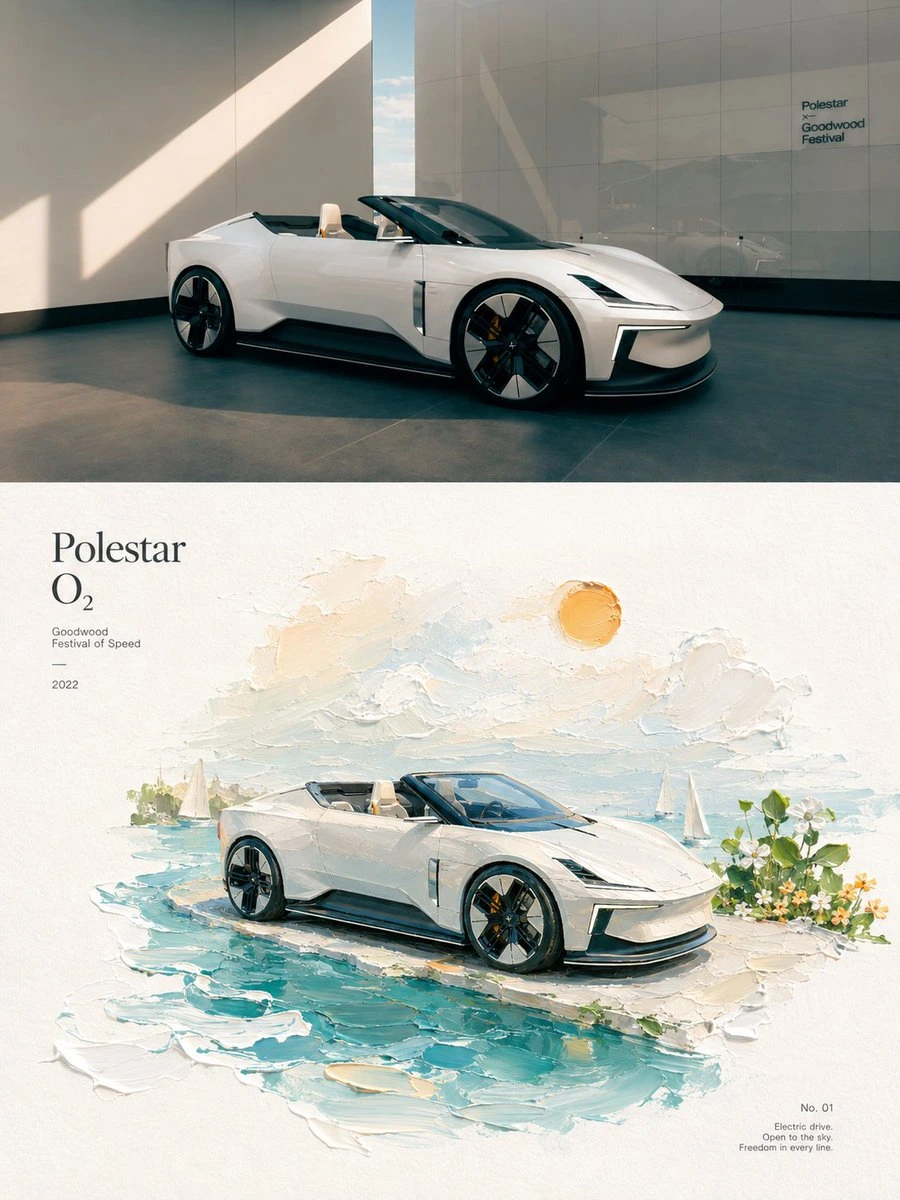
Complete AI image prompt
Build a two-stage visual event in which a credible real-world observation of the subject becomes a tactile miniature reinvention across a crisp dividing threshold. The upper field uses restrained natural photography to preserve recognizable proportions, the defining action, environmental evidence, and mood-setting light; choose one strong on-location device such as shallow depth, reflection, backlight, or a hard cast shadow. In the lower field, translate the same subject and viewing logic into a self-contained tabletop world rather than duplicating its literal surroundings: keep the main form immediately identifiable, recast its companions and symbolic cues as an optimistic condensed narrative, and let the theme determine every prop, attachment, material association, and information role. Give the two fields nearly equal authority. Let continuous atmosphere and deeper space carry the photographic half, while an expansive warm-white field isolates the reconstructed scene as a concentrated island in the lower half; the scene holds most of that field's weight, with title and annotations acting as light counterweights near open margins. Guide the eye from the photographed subject across the divide to its material counterpart, then around the base, attachments, and tiny narrative markers, maintaining generous intervals around the ensemble. Use one coherent physical grammar chosen from the theme's emotional temperature: rounded modular units with occasional transparent layers, immaculate geometric display solids, or palette-knife relief. Assemble silhouettes from interlocking masses with visible overlap, firm contact shadows, and believable weight; retain only the subject details essential to recognition, reducing the environment to a platform, distant emblematic forms, directional pieces, and a few theme-derived organic accents. In the painted branch, overlap short decisive knife strokes, concentrating raised ridges in clouds, water, foliage, and illuminated subject planes while the surrounding warm-white paper remains broad and even. In the modular branch, create equivalent tactility through smooth matte solids, lucid transparent pieces, precise rounded seams, and softly modeled joints. Extract a dominant hue, neighboring support hues, and a small high-chroma focal accent from the photographed theme; lift luminosity and optical clarity in the reconstruction while preserving the original warm-cool relationship and a decisive area hierarchy among warm white, theme color, and shadow. Continue one lighting direction through both stages, turning it into soft studio side light below with compact grounded shadows. Treat typography as quiet curatorial pacing: choose a brief theme-derived title in either a high-contrast serif, a fine geometric sans, or a light handwritten construction according to the mood, then add widely tracked microtype for numbering, short captions, and directional marks along the open edges. Match lettering to the valid anatomy of its writing system, using clear counters, controlled stroke rhythm, and generous spacing. Establish three readings—title, reconstructed scene, micro-annotation—without allowing type to overtake the image. The result feels fresh, still, finely crafted, and gently playful, elevating an observed moment into a collectible visual specimen.
Original style prompt
Build a two-stage visual event in which a credible real-world observation of the subject becomes a tactile miniature reinvention across a crisp dividing threshold. The upper field uses restrained natural photography to preserve recognizable proportions, the defining action, environmental evidence, and mood-setting light; choose one strong on-location device such as shallow depth, reflection, backlight, or a hard cast shadow. In the lower field, translate the same subject and viewing logic into a self-contained tabletop world rather than duplicating its literal surroundings: keep the main form immediately identifiable, recast its companions and symbolic cues as an optimistic condensed narrative, and let the theme determine every prop, attachment, material association, and information role. Give the two fields nearly equal authority. Let continuous atmosphere and deeper space carry the photographic half, while an expansive warm-white field isolates the reconstructed scene as a concentrated island in the lower half; the scene holds most of that field's weight, with title and annotations acting as light counterweights near open margins. Guide the eye from the photographed subject across the divide to its material counterpart, then around the base, attachments, and tiny narrative markers, maintaining generous intervals around the ensemble. Use one coherent physical grammar chosen from the theme's emotional temperature: rounded modular units with occasional transparent layers, immaculate geometric display solids, or palette-knife relief. Assemble silhouettes from interlocking masses with visible overlap, firm contact shadows, and believable weight; retain only the subject details essential to recognition, reducing the environment to a platform, distant emblematic forms, directional pieces, and a few theme-derived organic accents. In the painted branch, overlap short decisive knife strokes, concentrating raised ridges in clouds, water, foliage, and illuminated subject planes while the surrounding warm-white paper remains broad and even. In the modular branch, create equivalent tactility through smooth matte solids, lucid transparent pieces, precise rounded seams, and softly modeled joints. Extract a dominant hue, neighboring support hues, and a small high-chroma focal accent from the photographed theme; lift luminosity and optical clarity in the reconstruction while preserving the original warm-cool relationship and a decisive area hierarchy among warm white, theme color, and shadow. Continue one lighting direction through both stages, turning it into soft studio side light below with compact grounded shadows. Treat typography as quiet curatorial pacing: choose a brief theme-derived title in either a high-contrast serif, a fine geometric sans, or a light handwritten construction according to the mood, then add widely tracked microtype for numbering, short captions, and directional marks along the open edges. Match lettering to the valid anatomy of its writing system, using clear counters, controlled stroke rhythm, and generous spacing. Establish three readings—title, reconstructed scene, micro-annotation—without allowing type to overtake the image. The result feels fresh, still, finely crafted, and gently playful, elevating an observed moment into a collectible visual specimen.
More open images in the “Photo Restyling · Impasto · Pixel Art · 198” style