

Open prompts
sample 08 AI Image Prompt
sample 08, its complete AI image prompt, and the Good Morning & Daily Greetings · Good Morning · Line Art · 173 style are free to view and copy.
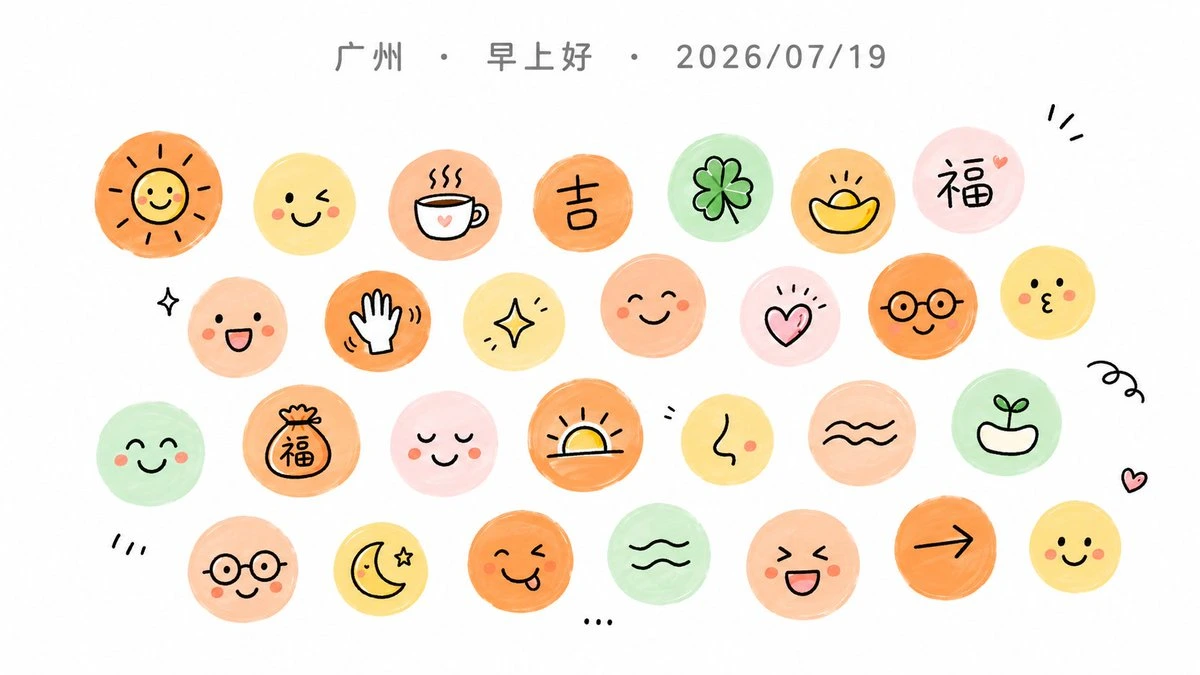
Complete AI image prompt
Build the first read around a subject identity unfolding into a breathable field of information. Let the subject supply a highly recognizable name, a short greeting or date line, characteristic environmental cues, and a family of compact emotional symbols. Keep two bounded expressions within one morning-themed design language, choosing according to narrative density: for environment-led content, balance an image mass roughly twice as wide as it is deep against generous paper white, using asymmetrical equilibrium, clear early-day natural light, shallow focus, and atmospheric distance; finish selected image edges with a broad rounded crop or sweeping arc that echoes an extremely fine path line crossing the open field with a single colored node. For symbol-led content, distill the subject into twenty to thirty translucent watercolor circles with gently varied sizes, arranged as a loose modular grid, shallow arch, or clustered silhouette, preserving a distinct breathing zone at the center or above and intervals that feel consistent yet hand placed. White remains the dominant area in either expression. Derive one restrained cool or warm structural hue from the subject, add one or two neighboring soft hues sparingly, and reserve black for lettering and icon contours; keep the value structure luminous, clear, and low contrast. Create a three-level typographic jump: the subject name acts as the anchor in a high-contrast Ming/Song-derived display skeleton or a poised handwritten skeleton, with legible components, decisive stroke modulation, and valid anatomy in the chosen writing system; accompanying Latin capitals use a slender high-contrast serif with expansive tracking and aligned optical weight. Greetings, dates, and descriptive copy recede into small gray-black type, organized by hairline frames, short dividers, circular badges, or wide tracking. Draw each icon with an even black monoline, rounded contour, and only enough detail for instant recognition; each colored circle carries one subject-derived expression, emblem, or miniature landmark, while sparse blush marks, sparkles, motion ticks, and arrows create a friendly cadence. Watercolor fills show hand-brushed boundaries, controlled transparency, and gentle density shifts, while the exposed white field and all typography remain smooth and bright. Direct the eye from greeting or date into the dominant photograph or symbol cluster, pause at the oversized identity, then release through a brief sentence, restrained annotations, and isolated small marks. Proximity, repetition, and alignment bind the modules, while one dominant block may cross the grid or one node may drift from the sequence as a controlled violation. The result feels awake, welcoming, and warmed by morning light: photography and hand-drawn symbols are interchangeable narrative layers, the subject determines scene, naming, hues, symbols, and copy, while broad white space, pronounced scale jumps, arc-and-node accents, lightweight icons, and airy editorial rhythm remain invariant.
Original style prompt
Build the first read around a subject identity unfolding into a breathable field of information. Let the subject supply a highly recognizable name, a short greeting or date line, characteristic environmental cues, and a family of compact emotional symbols. Keep two bounded expressions within one morning-themed design language, choosing according to narrative density: for environment-led content, balance an image mass roughly twice as wide as it is deep against generous paper white, using asymmetrical equilibrium, clear early-day natural light, shallow focus, and atmospheric distance; finish selected image edges with a broad rounded crop or sweeping arc that echoes an extremely fine path line crossing the open field with a single colored node. For symbol-led content, distill the subject into twenty to thirty translucent watercolor circles with gently varied sizes, arranged as a loose modular grid, shallow arch, or clustered silhouette, preserving a distinct breathing zone at the center or above and intervals that feel consistent yet hand placed. White remains the dominant area in either expression. Derive one restrained cool or warm structural hue from the subject, add one or two neighboring soft hues sparingly, and reserve black for lettering and icon contours; keep the value structure luminous, clear, and low contrast. Create a three-level typographic jump: the subject name acts as the anchor in a high-contrast Ming/Song-derived display skeleton or a poised handwritten skeleton, with legible components, decisive stroke modulation, and valid anatomy in the chosen writing system; accompanying Latin capitals use a slender high-contrast serif with expansive tracking and aligned optical weight. Greetings, dates, and descriptive copy recede into small gray-black type, organized by hairline frames, short dividers, circular badges, or wide tracking. Draw each icon with an even black monoline, rounded contour, and only enough detail for instant recognition; each colored circle carries one subject-derived expression, emblem, or miniature landmark, while sparse blush marks, sparkles, motion ticks, and arrows create a friendly cadence. Watercolor fills show hand-brushed boundaries, controlled transparency, and gentle density shifts, while the exposed white field and all typography remain smooth and bright. Direct the eye from greeting or date into the dominant photograph or symbol cluster, pause at the oversized identity, then release through a brief sentence, restrained annotations, and isolated small marks. Proximity, repetition, and alignment bind the modules, while one dominant block may cross the grid or one node may drift from the sequence as a controlled violation. The result feels awake, welcoming, and warmed by morning light: photography and hand-drawn symbols are interchangeable narrative layers, the subject determines scene, naming, hues, symbols, and copy, while broad white space, pronounced scale jumps, arc-and-node accents, lightweight icons, and airy editorial rhythm remain invariant.
More open images in the “Good Morning & Daily Greetings · Good Morning · Line Art · 173” style