

Open prompts
sample 08 AI Image Prompt
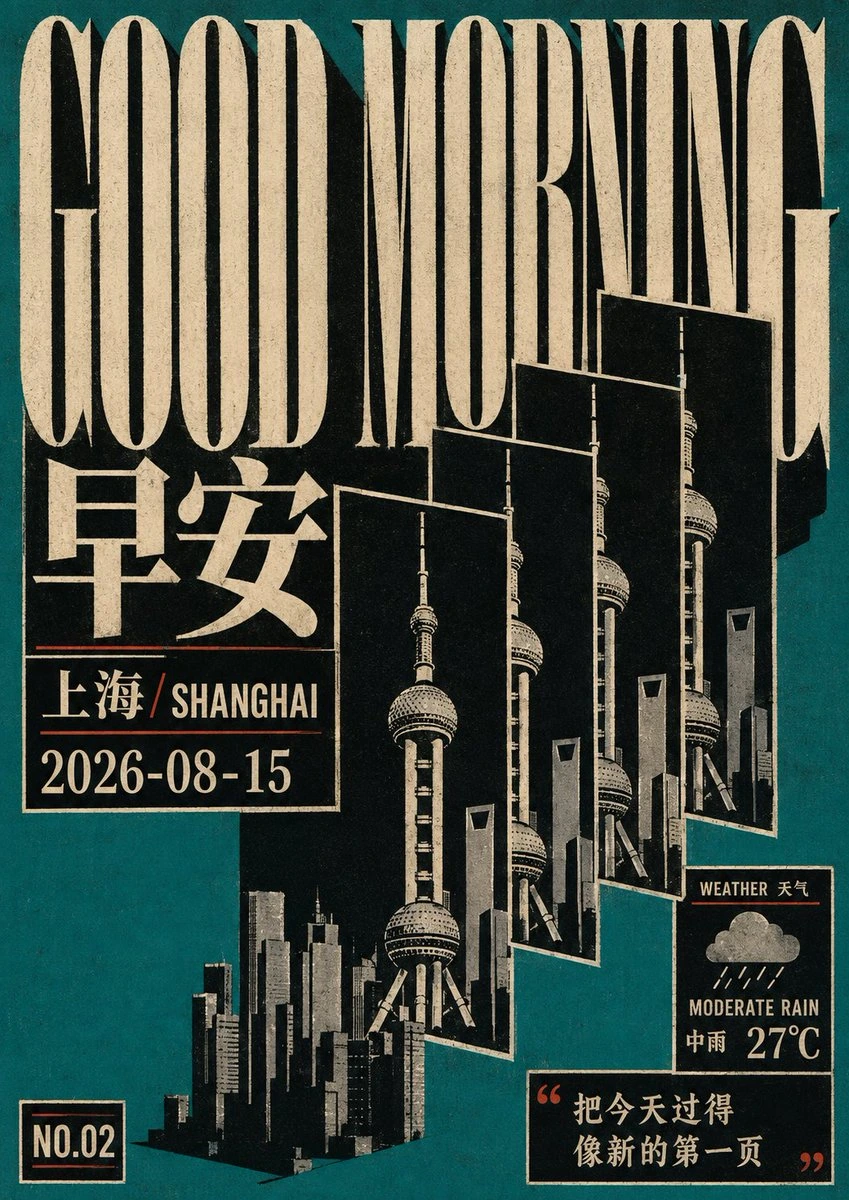
sample 08, its complete AI image prompt, and the Good Morning & Daily Greetings · Good Morning · Retro · 174 style are free to view and copy.
Complete AI image prompt
Build the first read from a collision between monumental morning lettering and a theme-defining silhouette. Stretch the upper Latin display line into extremely tall, narrow, high-contrast serif forms that press against the outer limits, then lock a massive heavy CJK headline beneath it by optical weight, with tight spacing, open counters, and valid glyph construction; the lettering must act as architecture that supports, masks, and cuts through the image. Reduce the theme's most recognizable form to a frontal or profile monument and repeat it five or six times in a disciplined progression: the nearest instance is largest and most resolved, bearing toward the lower edge, while matching copies recede upward along one diagonal or depth axis, shrink in measured steps, overlap one another, and sit inside dark rectangular stages. Continuity and partial closure should make the sequence feel like turning pages, ascending steps, or a temporal echo. Keep one dominant instance as the anchor and use the others strictly as rhythmic reinforcement; every new subject must supply its own emblematic outline, secondary contours, and symbolic structure to enact the same repetition. Govern the space through asymmetric dynamic balance: headline and primary subject outweigh all supporting matter by roughly four to one, the repeated chain carries the eye from display type through the image and into marginal data cards, and a restrained field of open color provides the distant counterweight. Align modules to shared edges and baselines, then deliberately break that grid with silhouettes crossing frames and selected image forms obscuring portions of type. Compress identity, date, conditions, temperature, and one short message into two or three black, thin-bordered editorial cards using tiny bilingual labels, condensed numerals, fine rules, compact icons, and disciplined spacing; place the message inside a quotation panel marked by a pair of vivid quotation marks. Preserve legibility, correct joins, clear counters, and the anatomy of whichever writing system is used. Derive the palette from the subject's emotional temperature, but limit it to one saturated field color, near-black structure, warm paper white, and a very small warning-color accent. Balance these as unequal flat areas: reserve paper white for major lettering, engraved subject planes, and essential data, and confine the accent to rules, numbers, icons, and quotation marks. Render the subject like a high-contrast relief print, combining a decisive contour, dense engraved hatching, solid black masses, and paper-white reserves; compress distant elements into simple silhouettes. Ground the finish in period commercial printing on warm uncoated stock: limited flat inks settle into the fibers, creating minute variation within printed solids and a slight bounded registration shift, while counters, fine rules, subject contours, and card borders remain crisp and intact. The final image should feel bold, optimistic, metropolitan, and collectible, with a clear information skeleton transformed into a forceful retro repetition system for any subject.
Original style prompt
Build the first read from a collision between monumental morning lettering and a theme-defining silhouette. Stretch the upper Latin display line into extremely tall, narrow, high-contrast serif forms that press against the outer limits, then lock a massive heavy CJK headline beneath it by optical weight, with tight spacing, open counters, and valid glyph construction; the lettering must act as architecture that supports, masks, and cuts through the image. Reduce the theme's most recognizable form to a frontal or profile monument and repeat it five or six times in a disciplined progression: the nearest instance is largest and most resolved, bearing toward the lower edge, while matching copies recede upward along one diagonal or depth axis, shrink in measured steps, overlap one another, and sit inside dark rectangular stages. Continuity and partial closure should make the sequence feel like turning pages, ascending steps, or a temporal echo. Keep one dominant instance as the anchor and use the others strictly as rhythmic reinforcement; every new subject must supply its own emblematic outline, secondary contours, and symbolic structure to enact the same repetition. Govern the space through asymmetric dynamic balance: headline and primary subject outweigh all supporting matter by roughly four to one, the repeated chain carries the eye from display type through the image and into marginal data cards, and a restrained field of open color provides the distant counterweight. Align modules to shared edges and baselines, then deliberately break that grid with silhouettes crossing frames and selected image forms obscuring portions of type. Compress identity, date, conditions, temperature, and one short message into two or three black, thin-bordered editorial cards using tiny bilingual labels, condensed numerals, fine rules, compact icons, and disciplined spacing; place the message inside a quotation panel marked by a pair of vivid quotation marks. Preserve legibility, correct joins, clear counters, and the anatomy of whichever writing system is used. Derive the palette from the subject's emotional temperature, but limit it to one saturated field color, near-black structure, warm paper white, and a very small warning-color accent. Balance these as unequal flat areas: reserve paper white for major lettering, engraved subject planes, and essential data, and confine the accent to rules, numbers, icons, and quotation marks. Render the subject like a high-contrast relief print, combining a decisive contour, dense engraved hatching, solid black masses, and paper-white reserves; compress distant elements into simple silhouettes. Ground the finish in period commercial printing on warm uncoated stock: limited flat inks settle into the fibers, creating minute variation within printed solids and a slight bounded registration shift, while counters, fine rules, subject contours, and card borders remain crisp and intact. The final image should feel bold, optimistic, metropolitan, and collectible, with a clear information skeleton transformed into a forceful retro repetition system for any subject.
More open images in the “Good Morning & Daily Greetings · Good Morning · Retro · 174” style