会员账号

Open prompts

Traditional Culture

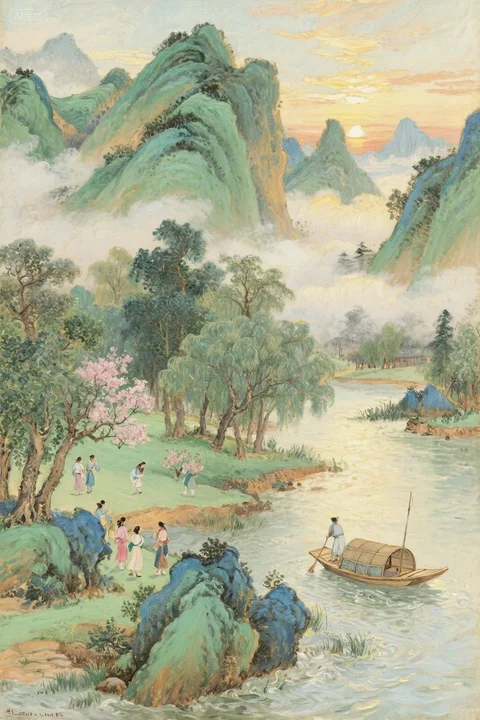
4 real examples in the Traditional Culture · Paper Texture · 039 style, with complete prompts available to copy without signing in.

Original style prompt

Build the first read around a tiny, lucid narrative focus carrying the subject's most recognizable motion or form, held inside a world of expansive pale air and layered surroundings. Establish a dramatic scale jump from monumental environmental mass, through a mid-scale guiding structure, to a compact living focus; keep that focus visually commanding through a close rhythmic grouping, decisive contours, concentrated warm chroma, and shared directional movement. Let roaming pictorial space and credible physical depth obey one continuous law: tactile, darker theme-derived forms press against the near frame; a bending path, shoreline, reflection, color band, or repeated motif draws a slow S-curve through the middle distance; a towering or broadly spread dominant mass anchors the distance. Thread luminous mist, open pale field, or translucent color through every plane, interrupting local contours while preserving continuity, so the eye travels from foreground detail to the small focus and across a bright interval into depth. Derive the protagonists, companions, motion, symbolism, and narrative clues from the chosen subject. Shape the focal ensemble as three or several related units moving together or answering one another, with restrained pose variation and an intimate, unhurried, light-scaled story. Hold painterly reduction and believable reality on the same spatial skeleton: resolve nearby thematic materials with touchable specificity, progressively compress contrast and detail through the middle and far planes, dissolve the furthest forms into milky atmosphere, then restore clarity at focal silhouettes and essential contact points, joining graphic shorthand to convincing volume. Draw the palette from the subject's emotional and material associations while preserving the role structure: a broad low-chroma blue-green, jade, or theme-equivalent cool field; warm pink, coral, apricot, or semantic equivalents reserved for the focus and a few echoes; ink-dark accents confined to structural definition; creamy light tones carrying sky, mist, and breathing room. Keep cool and warm areas deliberately unequal, with warm notes functioning as small signals and a restrained dawn-or-dusk glow opening the distance. Use high-key enveloping illumination, long quiet reflections on water or pale ground, transparent soft shadows, and continuously delicate, moist-looking surfaces. Vary edge behavior by depth: concise elastic ink contours or crisp lifelike boundaries define the key forms, damp color lightly diffuses within garments or thematic accents, and layered washes plus atmospheric falloff absorb environmental edges. Across the peripheral open field and between planes, allow a few free watercolor clouds, sparse ink dots, or theme-derived translucent color blooms to echo the depth structure while the central narrative remains calm and legible. The finished image should make the roaming order of classical painting feel newly embodied through soft-lit reality—serene, lucid, reticent, and gently alive—always preserving the core event of a small story traveling through a vast atmosphere.
正在加载…

找回密码

输入注册邮箱,我们会发送一封重置邮件。

确认删除

删除后将从网站中移除。

API 迁移

导入 API 配置