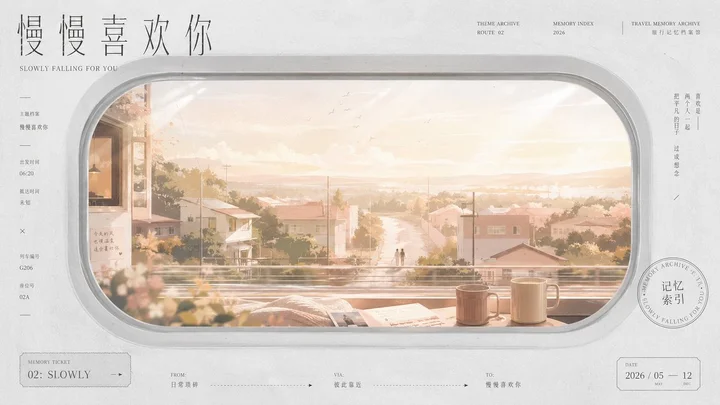
 sample 01Travel, Cities & Architecture · Glass · Paper Texture · 076
prompt library
成员提示词库
-
套提示词风格
- 全量解锁提示词、参数与案例
- 持续上新新提示词与实用场景
- 作者答疑使用问题直接沟通
正在确认当前可用的年度方案…
zhishixingqiu
知识星球
扫码加入星球,持续获取提示词更新、插件资料和项目答疑;星球会员也可以解锁成员提示词库。
 扫码或点击加入知识星球
认识小小东
添加微信,获取提示词、插件、Skills 与 AI 出图支持

扫描,添加小小东个人微信
built by xiaoxiaodong
我开发的项目
谷歌插件和 GitHub 项目分开展示
16 个可用项目chrome web store
谷歌插件
github
GitHub 项目
正在计算符合当前颜色的内容…
你已看完 10 页免费内容
开通 VIP,解锁完整提示词库。
开源 Skills
Skills
浏览小小东开源的 Codex / Agent Skills。按现有瀑布流节奏展开,找到合适的能力后即可复制安装命令。
正在加载 Skills…
没有找到匹配的 Skill。
Open prompts
Travel, Cities & Architecture
4 real examples in the Travel, Cities & Architecture · Glass · Paper Texture · 076 style, with complete prompts available to copy without signing in.
Original style prompt
Stage the subject as a memory that has been carefully archived yet remains in motion, first seen through an oversized round-cornered viewing window that dominates the composition. Build the opening as a tangible object: a thick pale gray-white rim, a narrow recessed shadow seam, and several nested radiused contours surrounding a deep, cinematic image. Keep the scene inside immersive and spatially legible, with foreground material cues, a trackable middle-distance route or horizon structure, and atmospheric falloff in the distance; let the subject determine the environment, symbolic forms, narrative incident, and emotional meaning. Include one very small figure, object, or trace of action as a scale and feeling anchor. Allow the subject's emotional temperature to move within a restrained range from translucent cool morning light to softly glowing warm evening light. Confine glass reflections to a few luminous streaks grazing the upper edge or crossing the window obliquely, so both the represented world and the physical act of viewing remain perceptible. Balance the large window against generous surrounding emptiness at roughly a three-to-one dominant-to-subordinate mass relationship. Use a calm axial grid, then introduce one controlled violation as a large headline, a ticket fragment, or a circular cancellation mark lightly enters the frame. Direct the eye into the image first, pull it toward the headline, circulate it through fine rules, nodes, dates, numbers, and terse annotations around the margins, then return it to the window. Set the outer field on warm ivory uncoated archival paper; fine paper fibers remain faintly visible only across the open margin, while photography, lettering, and rules stay clear and intact. Establish a luminous low-contrast field from the pale dimensional rim, restrained subject-derived imagery, and charcoal typography, with only one theme-derived blue, red, or neutral hue used sparingly for a route, stamp, ticket edge, or indexing accent. Construct the display lettering with exceptionally thin, tall, high-contrast strokes, stable centers of gravity, sharp tapered terminals, elongated proportions, and open spacing. Let its axis follow the information emphasis, either spanning an upper margin or pressing down a side column, while preserving authentic topology, counters, joins, terminals, rhythm, and orthographic recognition in the chosen writing system. Reduce all secondary copy to a fraction of the headline scale and form a disciplined archive hierarchy from widely tracked small serif capitals, narrow numerals, and minute body text. Generate the wording from the subject's own time, place, phase, emotion, and collection logic, expressed through coordinates, dates, serial numbers, route nodes, short rules, micro arrows, barcode-like ticks, and a circular postal seal. A ticket, map slip, or label may appear as a single optional paper overlay with shallow cast shadow, perforation or scoring, and one colored edge; a seal may cross the junction between paper and window to bind the information layer to the image layer. Preserve broad quiet margins, exact alignment, restrained ornament, soft high-key haze, and the combined logic of documentary spatial realism, a vehicle-window viewing experience, and rational editorial cataloguing.
sample 01Travel, Cities & Architecture · Glass · Paper Texture · 076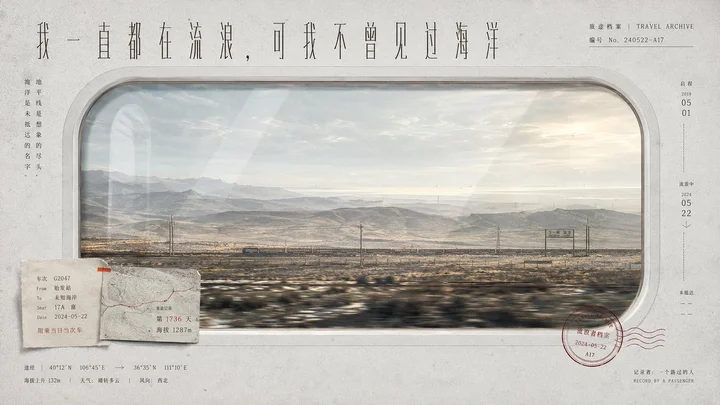 sample 02Travel, Cities & Architecture · Glass · Paper Texture · 076
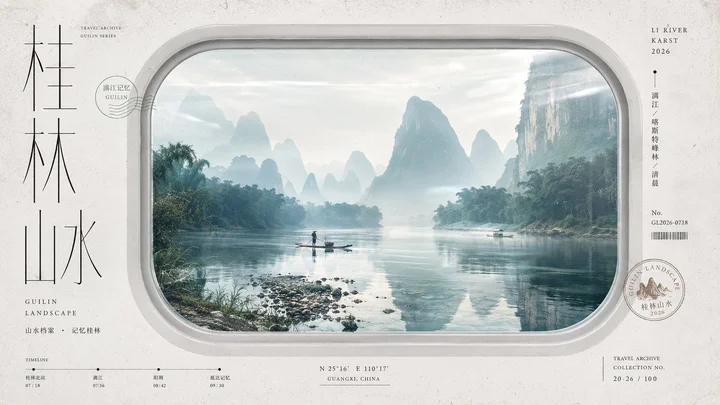 sample 03Travel, Cities & Architecture · Glass · Paper Texture · 076
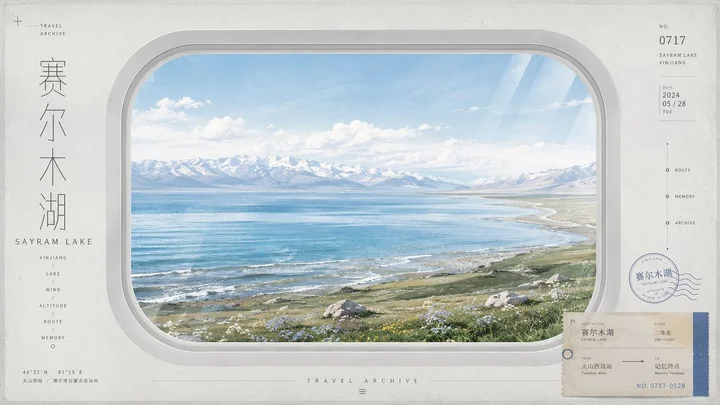 sample 04Travel, Cities & Architecture · Glass · Paper Texture · 076
正在计算符合当前颜色的内容…
VIP 收录全部风格 每周持续新增,开源的只是其中一小部分。
还没有通知
有新通知时会出现在这里。
批量管理
正在建设中,预计一周后内上线。
已选 0 组
点击卡片选择或取消,删除后无法恢复