会员账号

Open prompts

XXD Panel 042

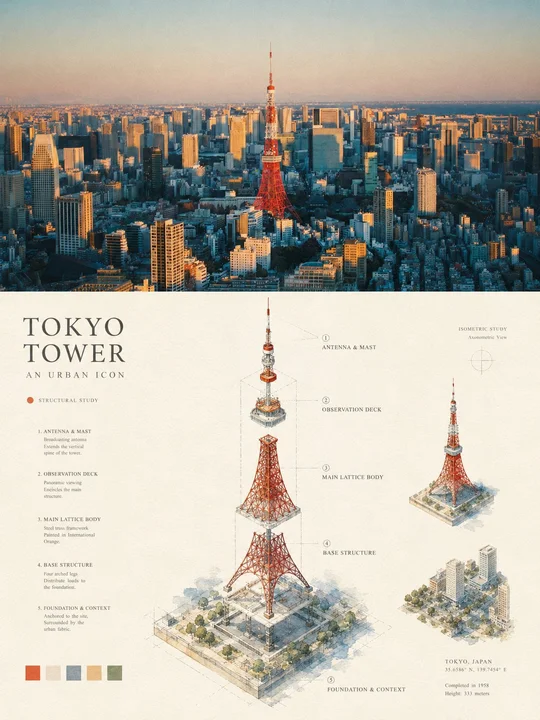
12 real examples in the XXD Panel 042 · Deconstructed Watercolor Journal style, with complete prompts available to copy without signing in.

Original style prompt

Please make every photo I upload into its own standalone high-end design poster; no multi-image collages, each photo output separately. The overall composition uses a 3:4 vertical format, with the upper and lower zones strictly 1:1 in height, each taking up 50% of the frame.

The upper half keeps the original photo, preserving the subject's identity, structure, proportions, viewpoint, orientation, perspective, real texture, natural light and shadow, and original color atmosphere, applying only a slight high-end photographic color grade so that it carries the texture of art magazines, independent publications, and exhibition photography. To fit the frame, the sky, ground, or environmental background may be extended naturally, but the subject must not be stretched, distorted, or altered, and no other objects may be mixed in or original content replaced.

The lower half extracts the most recognizable **subject, outline, pose, and narrative relationships** from the photo and reconstructs them as an **isometric-style structural deconstruction watercolor study**. The uploaded original photo is the sole basis; the subject's identity, geometric form, proportions, viewing direction, spatial relationships, main colors, and scale references may derive only from the original image. Do not paste the photo directly, and do not create a before-and-after comparison, collage, or photographic slices.

When redrawing, first identify the original image's core subject, principal axes, original viewing direction, foreground–middle ground–background relationships, 3–7 most important identifying features, 4–6 main colors, and environmental clues that convey scale. Preserve the subject's overall outline, general proportions, original viewpoint, symmetrical or asymmetrical relationships, relationships among key components, identity-defining details, and principal material colors, so that it is apparent at a glance that it is the same object as the one above.

The subject uses **isometric redrawing logic**, reorganized through a clear, restrained, professional axonometric spatial expression while remaining faithful to the original image's structural relationships and viewing logic. According to the subject's real structure, divide it into 2–5 meaningful, complete levels or components: buildings, objects, or composite objects may be deconstructed along roofs, floors, shells, frames, bases, modules, or connectors; landscapes or spaces may unfold by foreground, middle ground, background, and levels of spatial enclosure; people, animals, or plants must keep their bodies intact and be expressed only through overlapping outlines, pose layers, action lines, and surface color patches—dismemberment, anatomical dissection, or conversion into mechanical parts is prohibited. Every layer should be separated with restraint along real axes or perspective directions, with even, moderate spacing between layers, sharing the same central axis and spatial grid. Retain one complete, stable, most richly detailed base or anchor area, allowing viewers to mentally reassemble the subject.

The lower-half composition remains professional, restrained, and editorial. Center the subject or offset it slightly according to the original image's center of gravity, retain ample negative space around it, position the stable base in the lower area or center, and unfold the separated structural layers upward, outward, or into depth along real axes. Avoid dramatic shattering, excessively exploded views, meaningless decoration, and mechanical deconstruction. The whole should resemble a highly finished research-oriented editorial poster rather than an engineering manual.

The painting language adopts the character of an **architectural structural-deconstruction watercolor study on warm ivory watercolor paper**, potentially combining clear linework, translucent watercolor patches, a small number of structural guide lines, and restrained analytical marks. Retain slight paper grain, delicate brushstrokes, transparent color layering, and rational negative space, giving it both the knowledge-rich quality of a research diagram and the elegance of an art publication. Extract the colors from the original image and moderately purify them, keeping them clear, accurate, restrained, and spirited; avoid dullness, heaviness, over-rendering, and a cheap CG feel.

Text enters naturally as part of the composition in the form of **research-diagram / editorial annotations**. Distill a short title from the photo's subject identity, theme, action, state, or symbolic significance, paired with a minimal number of identifiers, structural labels, side annotations, material words, state words, or miniature explanations. Keep the text slender, restrained, and professional; it may be arranged horizontally, vertically, or in offset positions along axes, layering directions, edges of negative space, or structural-label locations, making it feel like a combination of architectural study, watercolor observation drawing, and high-end editorial design rather than an ordinary poster title.

The whole presents **isometric structural logic, professional deconstructive order, watercolor-study texture, editorial negative space, and the temperament of high-end publishing**. Whether the subject is a building, person, animal, plant, object, vehicle, streetscape, interior, or natural landscape, the lower half should grow the most appropriate mode of deconstruction from the original image's own structure, maintaining a high degree of adaptability and transferability. Avoid templated exploded views, complex technological UI, a sense of dismemberment, a mechanical-parts feel, a cartoon feel, an e-commerce feel, and baseless structural invention.

Maintain an overall balance among the **real subject, core meaning, miniature narrative, naive lines, and extensive negative space**. Whether the original image depicts a person, animal, plant, food, building, object, vehicle, or natural scene, first grasp “what this photo is really saying,” and only then decide how to reconstruct it. Avoid capturing objects without relationships, creating merely cute interactions with no theme, a cartoon-sticker feel, complex decoration, and a template feel.
正在加载…

找回密码

输入注册邮箱,我们会发送一封重置邮件。

确认删除

删除后将从网站中移除。

API 迁移

导入 API 配置