

Open prompts
en sample 07 AI Image Prompt
en sample 07, its complete AI image prompt, and the XXD Panel 093 · Modern Geometric Painting style are free to view and copy.
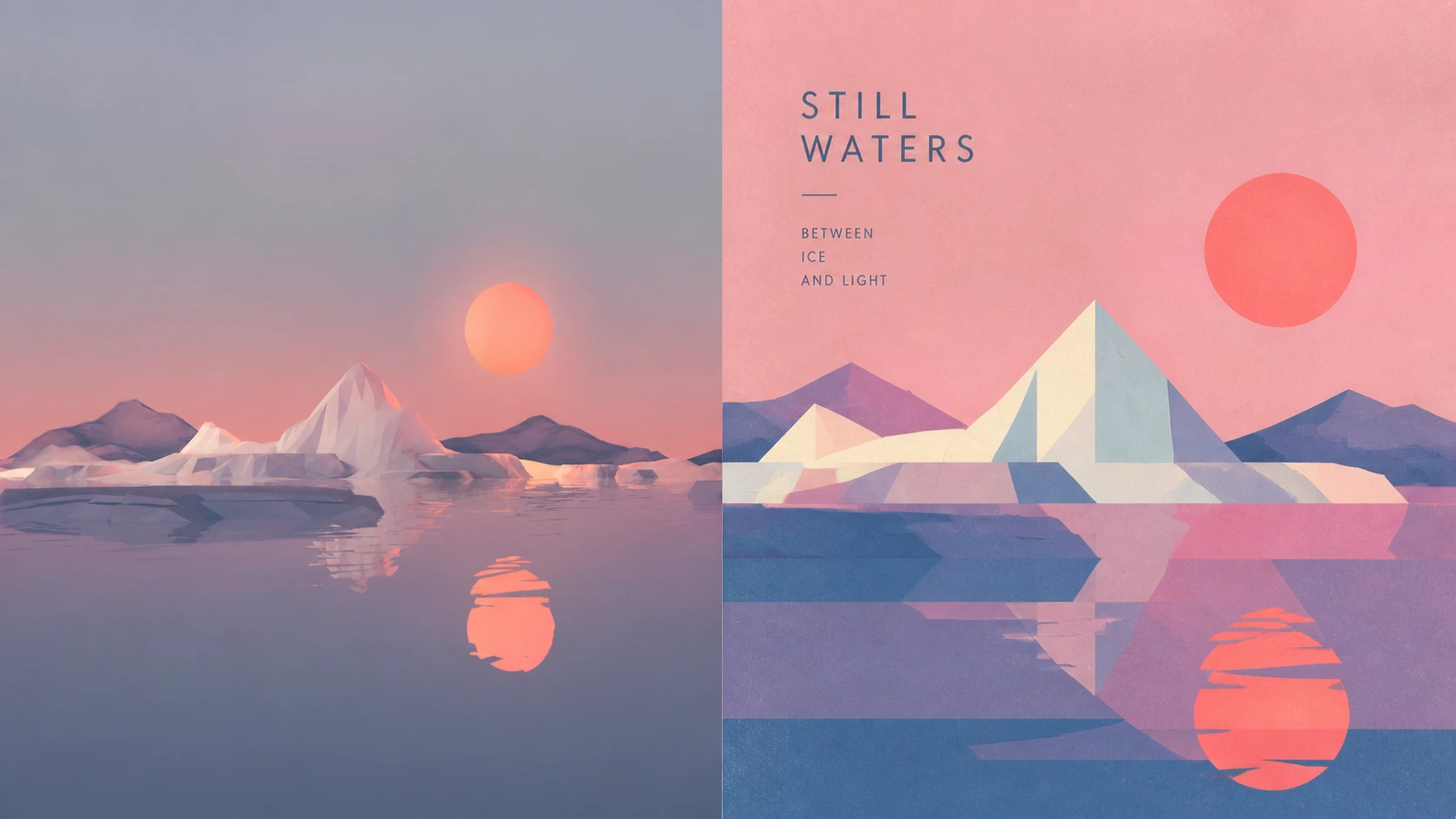
Complete AI image prompt
Turn every uploaded photograph into a separate premium design poster. Do not combine multiple photographs; output one poster for each photograph. Use an overall 3:4 portrait composition with two strictly equal top and bottom regions, each occupying 50% of the canvas.

Keep the original photograph in the upper half. Preserve the subject's identity, structure, pose, authentic texture, natural light and shadow, and original colour atmosphere. Apply only subtle premium colour grading so it feels like an art magazine, independent publication, or exhibition image. The surrounding environment may be extended naturally to fit the canvas, but the subject must not be stretched, distorted, or altered.

In the lower half, extract the photograph's most recognisable **subject, contour, structure, pose, and narrative relationships**, and reconstruct them as a modernist flat-colour illustration characterised by **Geometric stylization / Geometric simplification**. Do not describe the subject with geometric lines. Compress the subject itself directly into rectangles, trapezoids, triangles, circles, and a few free-form shapes, preserving its most important identifying traits with the fewest possible forms so the original remains immediately recognisable.

Use a pronounced **flattened pictorial space**. Reduce realistic perspective, volume, and representational light and shadow; establish space mainly through foreground–background overlap, changes of scale, layered colour fields, and vertical placement. Actively merge complex buildings, people, vehicles, plants, objects, and environmental details into a few large shape systems, and consolidate repeated elements into unified colour blocks rather than drawing them one by one. If the source is not urban, do not force it into an urban setting; use the same geometric method to reconstruct people, animals, still lifes, natural landscapes, or any other subject.

Emphasise **large-shape proportion, visual weight, layered relationships, positive and negative shapes, colour rhythm, and ordered whitespace**. The subject may be off-centre, cropped, overlapping, or extended naturally along horizontal or vertical axes. Give the image the flatness of cut paper and collage while retaining a clear narrative core. Do not distribute every element evenly or add meaningless decoration merely to make the image busier.

Build the forms from **large flat colour fields + subtly irregular hand-drawn edges + matte gouache/acrylic texture**. Paint surfaces should be fine, soft, and slightly varied in density, with the feel of hand-applied coverage. Edges may contain extremely subtle misregistration, brush marks, and cut-paper character, while the overall result remains clean and definite. Avoid digital gradients, realistic material simulation, complex shadows, photographic filters, and polished vector precision.

Extract and reorganise the photograph's **brightest, most vivid, and most memorable colours** rather than reproducing its colours literally. Gently brighten, purify, and remove greyness from the source hues to create a limited but clearly contrasting colour system. They may naturally become clear blue, aqua, fresh green, warm yellow, coral orange, peach pink, soft violet, cream white, and similar bright composite colours. Use warm–cool juxtaposition, differences of area, and value hierarchy to create a lively, restorative rhythm. Colour may be freer than reality but must preserve the source's spirit and colour memory. Avoid muddy greys, darkness, Morandi-style muting, fluorescent colour, and cheap candy tones.

Use text sparingly, with no preset wording or language. Freely distil only a few titles, phrases, or micro-notes from the photograph's place, subject, action, emotion, or cultural context. Set them in **simple editorial type with a subtle humanistic quality and mid-century modernist print character**. Text may sit in whitespace, follow the axis of a building or subject, touch the edge of a colour field, or align with a shape, so typography becomes part of the geometric composition rather than a title bar added afterwards.

The overall visual character should combine **Geometric urban illustration / Naïve modernist illustration / Mid-century inspired editorial illustration**: geometric forms, flattened space, vivid colour blocks, hand-drawn irregular edges, matte gouache texture, and professional editorial composition. Keep it modern, bright, restrained, unpretentious, and refined. Avoid realistic illustration, complex perspective, heavy light and shadow, cartoon-sticker character, polished vector appearance, 3D rendering, and templated travel-poster design.
Original style prompt
Turn every uploaded photograph into a separate premium design poster. Do not combine multiple photographs; output one poster for each photograph. Use an overall 3:4 portrait composition with two strictly equal top and bottom regions, each occupying 50% of the canvas.

Keep the original photograph in the upper half. Preserve the subject's identity, structure, pose, authentic texture, natural light and shadow, and original colour atmosphere. Apply only subtle premium colour grading so it feels like an art magazine, independent publication, or exhibition image. The surrounding environment may be extended naturally to fit the canvas, but the subject must not be stretched, distorted, or altered.

In the lower half, extract the photograph's most recognisable **subject, contour, structure, pose, and narrative relationships**, and reconstruct them as a modernist flat-colour illustration characterised by **Geometric stylization / Geometric simplification**. Do not describe the subject with geometric lines. Compress the subject itself directly into rectangles, trapezoids, triangles, circles, and a few free-form shapes, preserving its most important identifying traits with the fewest possible forms so the original remains immediately recognisable.

Use a pronounced **flattened pictorial space**. Reduce realistic perspective, volume, and representational light and shadow; establish space mainly through foreground–background overlap, changes of scale, layered colour fields, and vertical placement. Actively merge complex buildings, people, vehicles, plants, objects, and environmental details into a few large shape systems, and consolidate repeated elements into unified colour blocks rather than drawing them one by one. If the source is not urban, do not force it into an urban setting; use the same geometric method to reconstruct people, animals, still lifes, natural landscapes, or any other subject.

Emphasise **large-shape proportion, visual weight, layered relationships, positive and negative shapes, colour rhythm, and ordered whitespace**. The subject may be off-centre, cropped, overlapping, or extended naturally along horizontal or vertical axes. Give the image the flatness of cut paper and collage while retaining a clear narrative core. Do not distribute every element evenly or add meaningless decoration merely to make the image busier.

Build the forms from **large flat colour fields + subtly irregular hand-drawn edges + matte gouache/acrylic texture**. Paint surfaces should be fine, soft, and slightly varied in density, with the feel of hand-applied coverage. Edges may contain extremely subtle misregistration, brush marks, and cut-paper character, while the overall result remains clean and definite. Avoid digital gradients, realistic material simulation, complex shadows, photographic filters, and polished vector precision.

Extract and reorganise the photograph's **brightest, most vivid, and most memorable colours** rather than reproducing its colours literally. Gently brighten, purify, and remove greyness from the source hues to create a limited but clearly contrasting colour system. They may naturally become clear blue, aqua, fresh green, warm yellow, coral orange, peach pink, soft violet, cream white, and similar bright composite colours. Use warm–cool juxtaposition, differences of area, and value hierarchy to create a lively, restorative rhythm. Colour may be freer than reality but must preserve the source's spirit and colour memory. Avoid muddy greys, darkness, Morandi-style muting, fluorescent colour, and cheap candy tones.

Use text sparingly, with no preset wording or language. Freely distil only a few titles, phrases, or micro-notes from the photograph's place, subject, action, emotion, or cultural context. Set them in **simple editorial type with a subtle humanistic quality and mid-century modernist print character**. Text may sit in whitespace, follow the axis of a building or subject, touch the edge of a colour field, or align with a shape, so typography becomes part of the geometric composition rather than a title bar added afterwards.

The overall visual character should combine **Geometric urban illustration / Naïve modernist illustration / Mid-century inspired editorial illustration**: geometric forms, flattened space, vivid colour blocks, hand-drawn irregular edges, matte gouache texture, and professional editorial composition. Keep it modern, bright, restrained, unpretentious, and refined. Avoid realistic illustration, complex perspective, heavy light and shadow, cartoon-sticker character, polished vector appearance, 3D rendering, and templated travel-poster design.
More open images in the “XXD Panel 093 · Modern Geometric Painting” style