

Open prompts
en sample 08 AI Image Prompt
en sample 08, its complete AI image prompt, and the XXD Panel 047 · Isometric Impasto Scene style are free to view and copy.
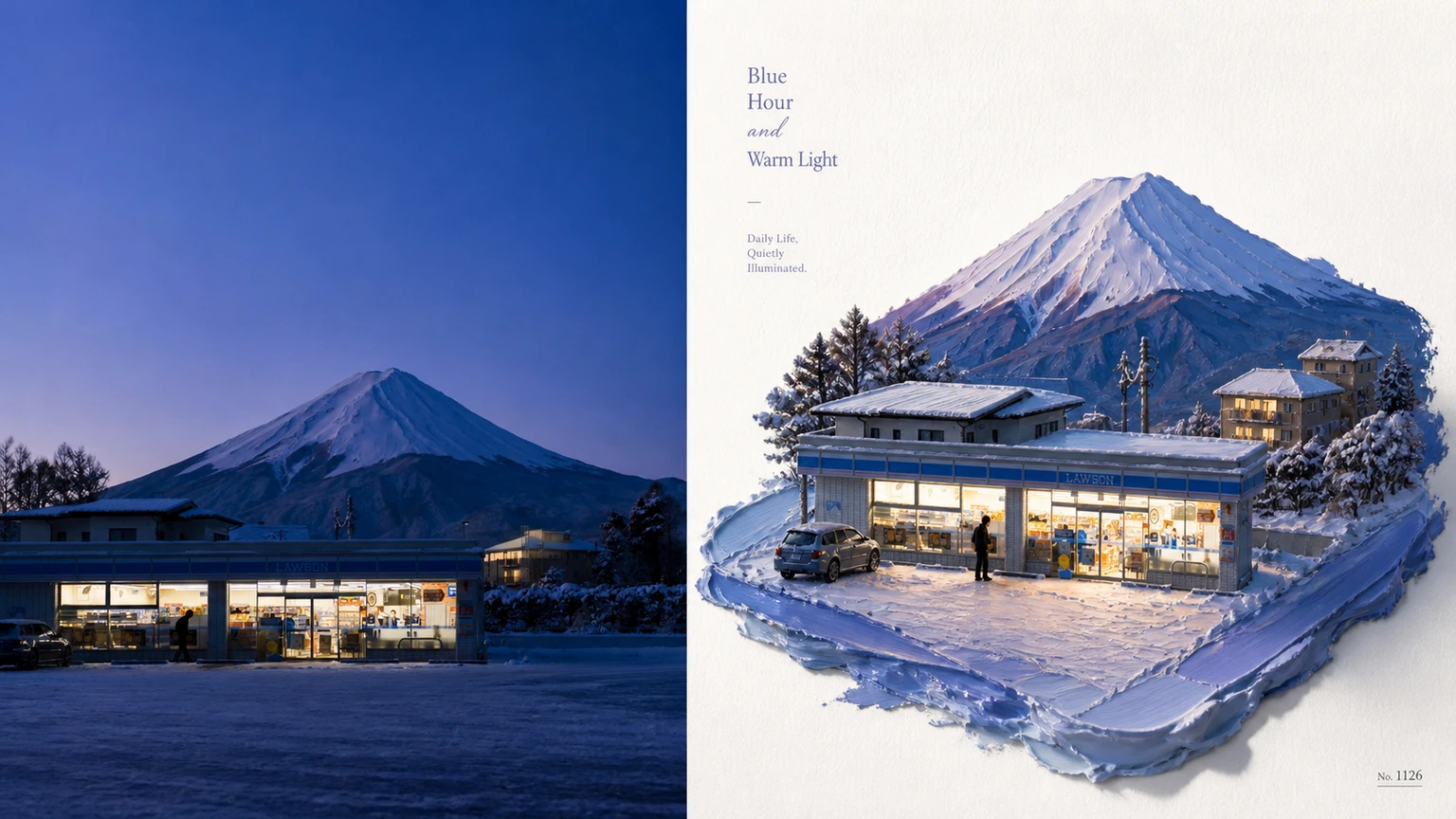
Complete AI image prompt
Please make every photo I upload into its own standalone high-end design poster; no multi-image collages, each photo output separately. The overall composition uses a 3:4 vertical format, with the upper and lower zones strictly 1:1 in height, each taking up 50% of the frame.

The upper half keeps the original photo, preserving the subject's structure, real texture, natural light and shadow, and original color atmosphere, applying only a slight high-end photographic color grade so that it carries the texture of art magazines, independent publications, and exhibition photography. To fit the frame, the sky, ground, or environmental background may be extended naturally, but the subject must not be stretched, distorted, or altered.

The lower half extracts the most recognizable **subject, outline, pose, and narrative relationships** from the photo and reconstructs them as a refined impasto miniature landscape using **isometric / axonometric 3D spatial logic**. The subject is not a flat illustration, but a dimensional miniature entity with clearly defined volume, structure, front-to-back relationships, and a stable point of contact. Retain the original object's most crucial identifying features, while moderately organizing the viewpoint and proportions so that it appears more complete, clear, and sculptural within a unified axonometric space.

The subject sits atop a **thematic color field** formed from impasto paint. The color block is not an ordinary rectangular background; according to the original image's content, it should be transformed into a water surface, ground, road, grassland, band of light, shoreline, shadow, or another theme-related spatial slice, and extend naturally along the isometric perspective direction. The subject must have a real spatial relationship with the color block: it may touch down, embed itself, pass through, extend, reflect, ripple, cast a shadow, or partially cross the boundary, ingeniously connecting two-dimensional impasto brushstrokes with the three-dimensional subject.

The composition adapts to the subject's volume, orientation, and direction of movement, establishing a professional spatial order through a **diagonal axonometric axis, stable center of gravity, front-to-back depth, and large areas of negative space**. The subject is usually located at a key node of the color block rather than mechanically centered; the color block guides the eye and extends the perspective. When necessary, a low-weight group of clouds, sun, plants, ripples, or abstract natural imagery may be added to form foreground and background layers with the subject, but without establishing a second visual center.

The painting language fuses a **dimensional miniature model × impasto oil painting × real paper surface**. The subject's details are refined and its volume is clear, while the surrounding environment retains visible palette-knife marks, thick paint buildup, raised edges, and handmade brushstrokes. Clouds, water, ground, and light may have an almost relief-like thickness of oil paint, creating the tactile illusion of "a real model standing on oil paint that has not yet dried."

The color scheme extracts and remixes the **brightest, most vivid colors from the photo above that best represent the subject's spirit**, increasing brightness, purity, and vitality. Use abundant clean warm white as breathing room, paired with translucent main colors and a small number of sunlight-like warm accents. The whole should be bright, healing, vivid, and high-end. Avoid dirty gray, subdued colors, Morandi treatment, a fluorescent feel, and cheap candy colors.

Text intervenes sparingly: distill a short title from the subject, location, mood, or symbolic meaning in the photo, and pair it with a minimal amount of secondary text, numbering, or micro-annotations. Keep the typography delicate and restrained; it may follow the axonometric direction, the edge of an impasto color block, or a blank area, subtly echoing the spatial perspective rather than appearing as a title independently pasted onto the image.

The overall result presents the visual relationship of an **isometric dimensional subject × impasto color field × bright healing color scheme × real paper × large areas of negative space**. Whether the subject is a building, person, animal, plant, object, vehicle, or natural landscape, the three-dimensional subject should truly "stand, grow, or exist" within the space formed by the impasto color blocks. Avoid flat pasted graphics, ordinary illustration, plastic CG, a toy-model feel, and formulaic miniature landscapes.
Original style prompt
Please make every photo I upload into its own standalone high-end design poster; no multi-image collages, each photo output separately. The overall composition uses a 3:4 vertical format, with the upper and lower zones strictly 1:1 in height, each taking up 50% of the frame.

The upper half keeps the original photo, preserving the subject's structure, real texture, natural light and shadow, and original color atmosphere, applying only a slight high-end photographic color grade so that it carries the texture of art magazines, independent publications, and exhibition photography. To fit the frame, the sky, ground, or environmental background may be extended naturally, but the subject must not be stretched, distorted, or altered.

The lower half extracts the most recognizable **subject, outline, pose, and narrative relationships** from the photo and reconstructs them as a refined impasto miniature landscape using **isometric / axonometric 3D spatial logic**. The subject is not a flat illustration, but a dimensional miniature entity with clearly defined volume, structure, front-to-back relationships, and a stable point of contact. Retain the original object's most crucial identifying features, while moderately organizing the viewpoint and proportions so that it appears more complete, clear, and sculptural within a unified axonometric space.

The subject sits atop a **thematic color field** formed from impasto paint. The color block is not an ordinary rectangular background; according to the original image's content, it should be transformed into a water surface, ground, road, grassland, band of light, shoreline, shadow, or another theme-related spatial slice, and extend naturally along the isometric perspective direction. The subject must have a real spatial relationship with the color block: it may touch down, embed itself, pass through, extend, reflect, ripple, cast a shadow, or partially cross the boundary, ingeniously connecting two-dimensional impasto brushstrokes with the three-dimensional subject.

The composition adapts to the subject's volume, orientation, and direction of movement, establishing a professional spatial order through a **diagonal axonometric axis, stable center of gravity, front-to-back depth, and large areas of negative space**. The subject is usually located at a key node of the color block rather than mechanically centered; the color block guides the eye and extends the perspective. When necessary, a low-weight group of clouds, sun, plants, ripples, or abstract natural imagery may be added to form foreground and background layers with the subject, but without establishing a second visual center.

The painting language fuses a **dimensional miniature model × impasto oil painting × real paper surface**. The subject's details are refined and its volume is clear, while the surrounding environment retains visible palette-knife marks, thick paint buildup, raised edges, and handmade brushstrokes. Clouds, water, ground, and light may have an almost relief-like thickness of oil paint, creating the tactile illusion of "a real model standing on oil paint that has not yet dried."

The color scheme extracts and remixes the **brightest, most vivid colors from the photo above that best represent the subject's spirit**, increasing brightness, purity, and vitality. Use abundant clean warm white as breathing room, paired with translucent main colors and a small number of sunlight-like warm accents. The whole should be bright, healing, vivid, and high-end. Avoid dirty gray, subdued colors, Morandi treatment, a fluorescent feel, and cheap candy colors.

Text intervenes sparingly: distill a short title from the subject, location, mood, or symbolic meaning in the photo, and pair it with a minimal amount of secondary text, numbering, or micro-annotations. Keep the typography delicate and restrained; it may follow the axonometric direction, the edge of an impasto color block, or a blank area, subtly echoing the spatial perspective rather than appearing as a title independently pasted onto the image.

The overall result presents the visual relationship of an **isometric dimensional subject × impasto color field × bright healing color scheme × real paper × large areas of negative space**. Whether the subject is a building, person, animal, plant, object, vehicle, or natural landscape, the three-dimensional subject should truly "stand, grow, or exist" within the space formed by the impasto color blocks. Avoid flat pasted graphics, ordinary illustration, plastic CG, a toy-model feel, and formulaic miniature landscapes.
More open images in the “XXD Panel 047 · Isometric Impasto Scene” style