

Open prompts
en sample 08 AI Image Prompt
en sample 08, its complete AI image prompt, and the XXD Panel 080 · Organic Gouache Field style are free to view and copy.
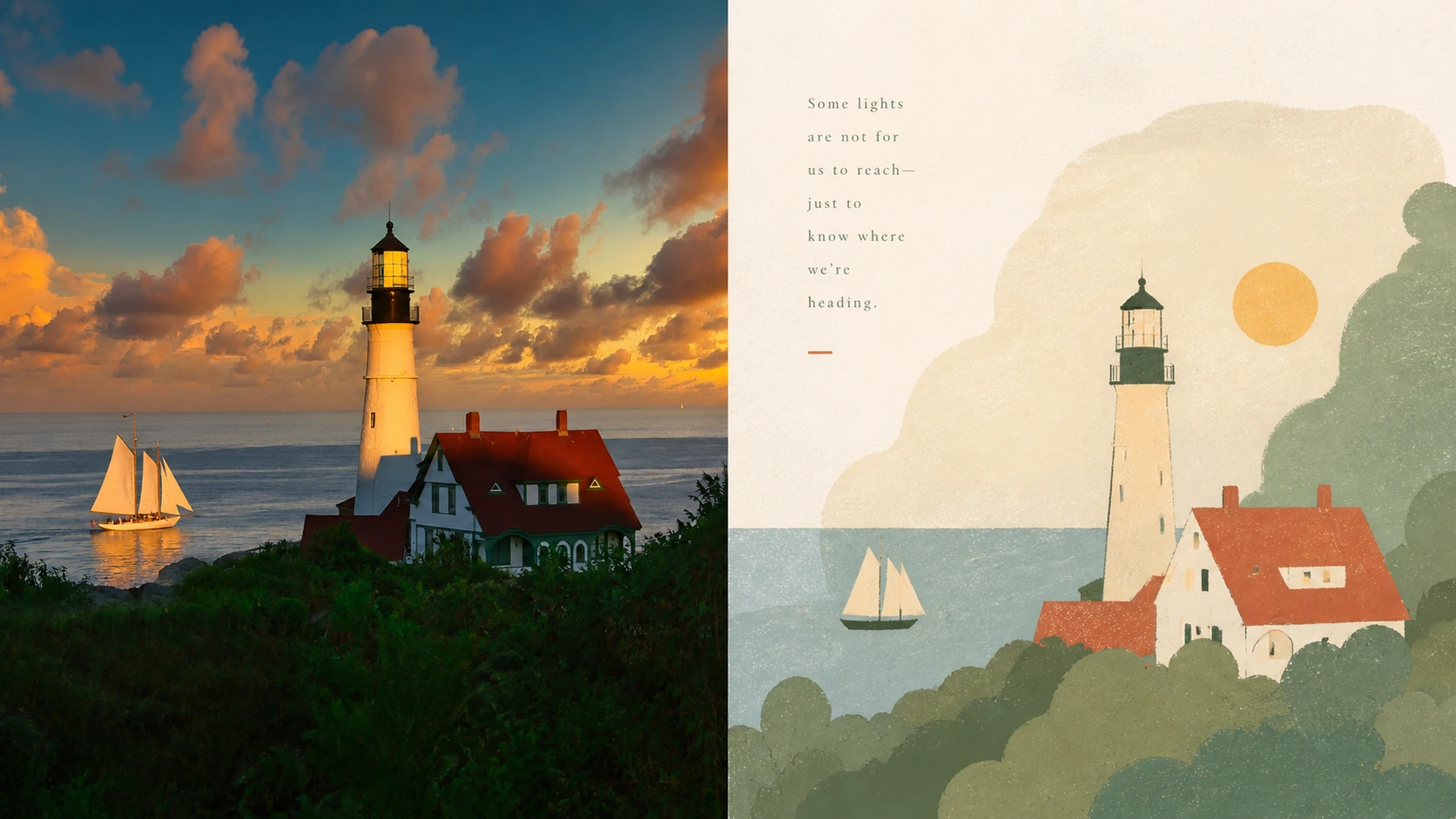
Complete AI image prompt
Please turn every photograph I upload into a separate high-end design poster. Do not create a multi-image collage; output each photograph independently. Use an overall 3:4 portrait composition with upper and lower regions in a strict 1:1 height ratio, each occupying 50% of the canvas.

Retain the original photograph in the upper half, preserving the subject's identity, structure, pose, authentic texture, natural light and shadow, and original colour atmosphere. Apply only subtle, refined colour grading so that it has the quality of an art magazine, independent publication, or exhibition image. The surrounding environment may be extended naturally to fit the format, but the subject must not be stretched, distorted, or altered.

In the lower half, extract the photograph's most recognisable **subject, contour, structure, pose, and narrative relationship**, while also understanding the image's true **core theme, emotion, and latent metaphor**, then reconstruct it through selective memory. Do not mechanically replicate the photograph or merely decorate its surface. Retain only a few visual clues that best represent the spirit of this photograph, letting the subject, environment, and one symbolic detail carry the narrative together, so that the original is immediately recognisable while its distilled emotional expression can also be felt.

Use **digital gouache / digital crayon brushes + flat colour fields + granular noise texture**. Summarise the subject through flexible organic geometry, broad silhouettes, and unoutlined colour shapes, weakening realistic perspective and naturalistic light and shadow. Add only a very small amount of hand-drawn line, crayon trace, and granular gouache texture in selected areas, so the forms remain concise while retaining the warmth of genuine handwork. Actively remove complex backgrounds, trivial structures, and meaningless detail.

The composition should emphasise **generous whitespace and emotional space**. The subject need not fill the canvas; it may be reduced in scale, offset, locally cropped, or placed in isolation. Use differences in scale, a sense of distance, positive and negative form, density and openness, and directional relationships to reshape the source's genuine quietness, solitude, warmth, ease, anticipation, freedom, or other emotion. Whitespace is not an absence: it actively carries air, time, distance, silence, and imagination, creating the poetry that “what is not drawn matters just as much.”

Find one subtle **visual metaphor** within the source photograph: for example, plant growth may represent vitality, a small distant object may represent distance, repeated forms may represent rhythm, an isolated subject may represent quietness, a path may represent moving forward, and occlusion or whitespace may represent memory and absence. The metaphor must arise naturally from the source. Do not force a new story onto it or accumulate symbolic signs.

Use a **low-saturation botanical colour logic**, remixed from the upper photograph's overall colour temperature and characteristic hues. Let sage green and olive green form the principal base, supported by creamy yellow, grey-blue, and soft neutrals, with small areas of coral pink, apricot orange, mustard yellow, or other warm colours brightening the emotion. The whole should feel gentle, natural, and restorative, but never dim or lifeless. Preserve a measured yet distinct vitality of colour, building emotion through warm–cool relationships, area, and value rather than relying on gradients and realistic lighting.

Use text sparingly, without presetting a fixed title, place, number, or language. Freely distil a small number of genuinely meaningful words or short phrases from the photograph's theme, action, memory, emotion, or metaphor, and let them form a natural image–text relationship with the subject, colour fields, and generous whitespace. Keep the typography light, small, restrained, and breathable. It should not explain the image, but feel like a line of observation or an emotional footnote left in an independent publication.

The overall result should unite **flexible organic geometry, digital gouache, granular texture, a botanical palette, core narrative, distilled metaphor, generous whitespace, and emotional reconstruction** into a sophisticated visual character: quiet, natural, perceptive, gentle, relaxed, and alive, with mature compositional awareness and the sensibility of art publishing. Avoid mere botanical decoration, filled backgrounds, accumulated detail, meaningless symbols, cartoon styling, polished vectors, 3D rendering, and template-like commercial illustration.
Original style prompt
Please turn every photograph I upload into a separate high-end design poster. Do not create a multi-image collage; output each photograph independently. Use an overall 3:4 portrait composition with upper and lower regions in a strict 1:1 height ratio, each occupying 50% of the canvas.

Retain the original photograph in the upper half, preserving the subject's identity, structure, pose, authentic texture, natural light and shadow, and original colour atmosphere. Apply only subtle, refined colour grading so that it has the quality of an art magazine, independent publication, or exhibition image. The surrounding environment may be extended naturally to fit the format, but the subject must not be stretched, distorted, or altered.

In the lower half, extract the photograph's most recognisable **subject, contour, structure, pose, and narrative relationship**, while also understanding the image's true **core theme, emotion, and latent metaphor**, then reconstruct it through selective memory. Do not mechanically replicate the photograph or merely decorate its surface. Retain only a few visual clues that best represent the spirit of this photograph, letting the subject, environment, and one symbolic detail carry the narrative together, so that the original is immediately recognisable while its distilled emotional expression can also be felt.

Use **digital gouache / digital crayon brushes + flat colour fields + granular noise texture**. Summarise the subject through flexible organic geometry, broad silhouettes, and unoutlined colour shapes, weakening realistic perspective and naturalistic light and shadow. Add only a very small amount of hand-drawn line, crayon trace, and granular gouache texture in selected areas, so the forms remain concise while retaining the warmth of genuine handwork. Actively remove complex backgrounds, trivial structures, and meaningless detail.

The composition should emphasise **generous whitespace and emotional space**. The subject need not fill the canvas; it may be reduced in scale, offset, locally cropped, or placed in isolation. Use differences in scale, a sense of distance, positive and negative form, density and openness, and directional relationships to reshape the source's genuine quietness, solitude, warmth, ease, anticipation, freedom, or other emotion. Whitespace is not an absence: it actively carries air, time, distance, silence, and imagination, creating the poetry that “what is not drawn matters just as much.”

Find one subtle **visual metaphor** within the source photograph: for example, plant growth may represent vitality, a small distant object may represent distance, repeated forms may represent rhythm, an isolated subject may represent quietness, a path may represent moving forward, and occlusion or whitespace may represent memory and absence. The metaphor must arise naturally from the source. Do not force a new story onto it or accumulate symbolic signs.

Use a **low-saturation botanical colour logic**, remixed from the upper photograph's overall colour temperature and characteristic hues. Let sage green and olive green form the principal base, supported by creamy yellow, grey-blue, and soft neutrals, with small areas of coral pink, apricot orange, mustard yellow, or other warm colours brightening the emotion. The whole should feel gentle, natural, and restorative, but never dim or lifeless. Preserve a measured yet distinct vitality of colour, building emotion through warm–cool relationships, area, and value rather than relying on gradients and realistic lighting.

Use text sparingly, without presetting a fixed title, place, number, or language. Freely distil a small number of genuinely meaningful words or short phrases from the photograph's theme, action, memory, emotion, or metaphor, and let them form a natural image–text relationship with the subject, colour fields, and generous whitespace. Keep the typography light, small, restrained, and breathable. It should not explain the image, but feel like a line of observation or an emotional footnote left in an independent publication.

The overall result should unite **flexible organic geometry, digital gouache, granular texture, a botanical palette, core narrative, distilled metaphor, generous whitespace, and emotional reconstruction** into a sophisticated visual character: quiet, natural, perceptive, gentle, relaxed, and alive, with mature compositional awareness and the sensibility of art publishing. Avoid mere botanical decoration, filled backgrounds, accumulated detail, meaningless symbols, cartoon styling, polished vectors, 3D rendering, and template-like commercial illustration.
More open images in the “XXD Panel 080 · Organic Gouache Field” style