

Open prompts
sample 02 AI Image Prompt
sample 02, its complete AI image prompt, and the Photo Restyling · Printmaking · 3D · 202 style are free to view and copy.
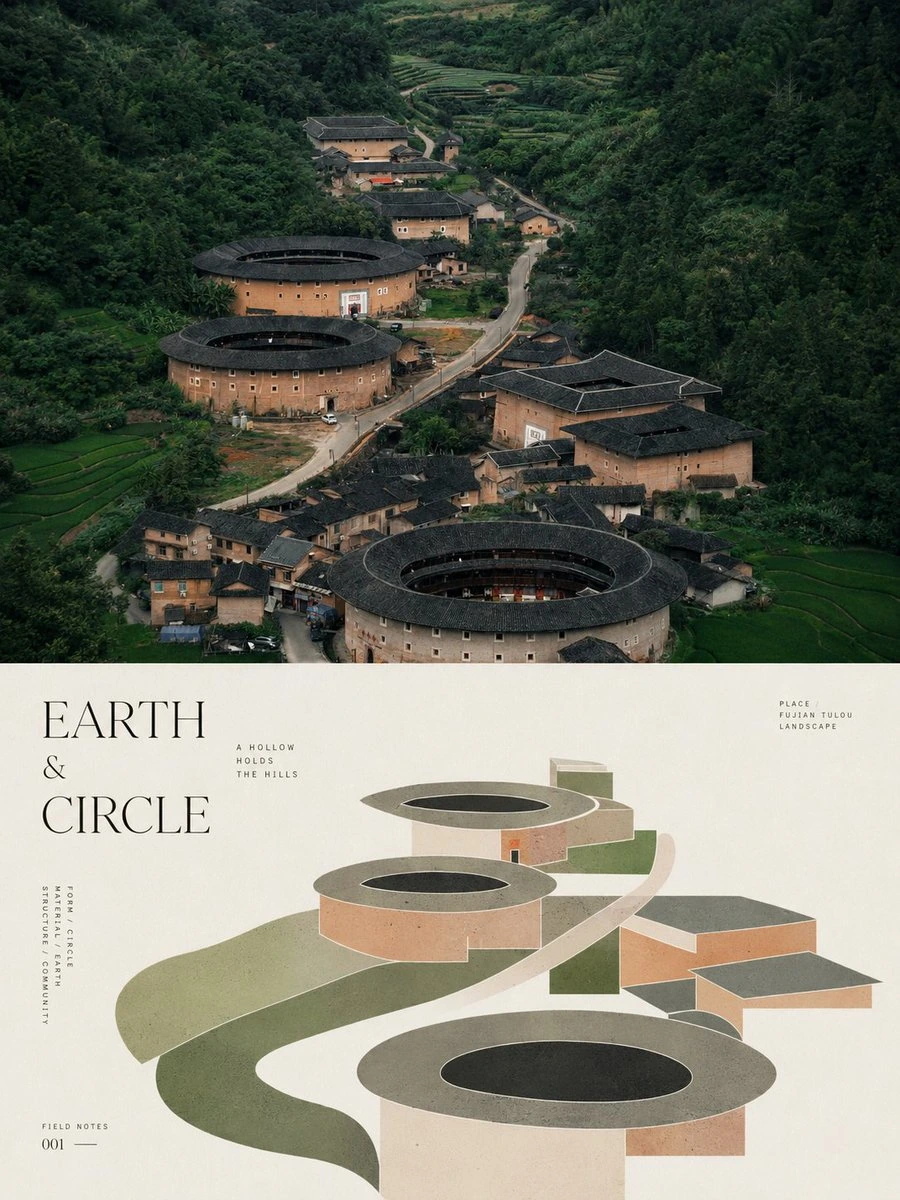
Complete AI image prompt
Build a two-register visual study in which one subject passes from witnessed reality into editorial interpretation. Give the upper register the dominant visual weight through full-bleed documentary photography: a lucid environment with legible terrain, architecture, interior space, weather, light, or material relationships, organized by a calm horizon or a forceful structural axis, with broad depth and one very small yet unmistakable subject carrier establishing stillness, distance, and scale. At a decisive boundary, open the lower register into a warm paper-white field with expansive breathing room, then restate the photograph's defining silhouette, route, reflection, illumination, or directional force as a sparse thematic diagram. The two registers must cause each other: when the subject's identity is structural, compress it into overlapping circles, arcs, rectangles, inclined planes, cutout voids, continuous contours, flat ink shapes, and restrained translucent overlaps; when its identity is kinetic or atmospheric, let fine lines, sweeping trajectories, and point impressions move around a reduced subject emblem, shifting from concentrated to dispersed density so speed, wind, water, or spatial pressure becomes visible. Select one of these grammars as dominant and let the other appear only as a quiet support. Preserve a small recurring subject symbol as the scale anchor between photograph and abstraction. Govern the composition through dynamic opposition: dense image against open diagram, monumental setting against minute carrier, physical evidence against distilled explanation. The eye should enter through the photographic world, cross the clean division, travel along the principal contour or flow field, and settle on sparse marginal information; isolate the central diagram while metadata withdraws to corners and side edges. Derive color from the photographed subject and its emotional temperature: allow natural chroma and full tonal depth above, then reduce the lower register to one to three flat spot inks, assigning the thematic hue to the diagram, a dark structural tone to type and anchors, and paper white to silence, with strongly unequal color areas and only a minute contrasting marker. Use restrained field-archive typography: either a large high-contrast serif display or an airy condensed sans entry, supported by tiny monospaced or widely tracked uppercase metadata, brief captions, observation numbers, coordinate-like data, short rules, and occasional vertical marginal notes. Generate all wording from the subject's place, time, condition, observation, and scale; keep valid target-script anatomy, crisp terminals, measured spacing, and a clear hierarchy. In the lower register, use lightly warm uncoated fiber paper and flat spot ink whose absorption creates fine broken deposits and controlled density falloff only inside the diagrammatic marks, while the broad paper field, letterforms, and geometric boundaries remain even and precise. Keep the photograph optically clear, sharply resolved, and natural, producing a quiet, analytical, collectible visual research artifact.
Original style prompt
Build a two-register visual study in which one subject passes from witnessed reality into editorial interpretation. Give the upper register the dominant visual weight through full-bleed documentary photography: a lucid environment with legible terrain, architecture, interior space, weather, light, or material relationships, organized by a calm horizon or a forceful structural axis, with broad depth and one very small yet unmistakable subject carrier establishing stillness, distance, and scale. At a decisive boundary, open the lower register into a warm paper-white field with expansive breathing room, then restate the photograph's defining silhouette, route, reflection, illumination, or directional force as a sparse thematic diagram. The two registers must cause each other: when the subject's identity is structural, compress it into overlapping circles, arcs, rectangles, inclined planes, cutout voids, continuous contours, flat ink shapes, and restrained translucent overlaps; when its identity is kinetic or atmospheric, let fine lines, sweeping trajectories, and point impressions move around a reduced subject emblem, shifting from concentrated to dispersed density so speed, wind, water, or spatial pressure becomes visible. Select one of these grammars as dominant and let the other appear only as a quiet support. Preserve a small recurring subject symbol as the scale anchor between photograph and abstraction. Govern the composition through dynamic opposition: dense image against open diagram, monumental setting against minute carrier, physical evidence against distilled explanation. The eye should enter through the photographic world, cross the clean division, travel along the principal contour or flow field, and settle on sparse marginal information; isolate the central diagram while metadata withdraws to corners and side edges. Derive color from the photographed subject and its emotional temperature: allow natural chroma and full tonal depth above, then reduce the lower register to one to three flat spot inks, assigning the thematic hue to the diagram, a dark structural tone to type and anchors, and paper white to silence, with strongly unequal color areas and only a minute contrasting marker. Use restrained field-archive typography: either a large high-contrast serif display or an airy condensed sans entry, supported by tiny monospaced or widely tracked uppercase metadata, brief captions, observation numbers, coordinate-like data, short rules, and occasional vertical marginal notes. Generate all wording from the subject's place, time, condition, observation, and scale; keep valid target-script anatomy, crisp terminals, measured spacing, and a clear hierarchy. In the lower register, use lightly warm uncoated fiber paper and flat spot ink whose absorption creates fine broken deposits and controlled density falloff only inside the diagrammatic marks, while the broad paper field, letterforms, and geometric boundaries remain even and precise. Keep the photograph optically clear, sharply resolved, and natural, producing a quiet, analytical, collectible visual research artifact.
More open images in the “Photo Restyling · Printmaking · 3D · 202” style