

Open prompts
sample 03 AI Image Prompt
sample 03, its complete AI image prompt, and the Photo Restyling · Watercolor · Vector · 215 style are free to view and copy.
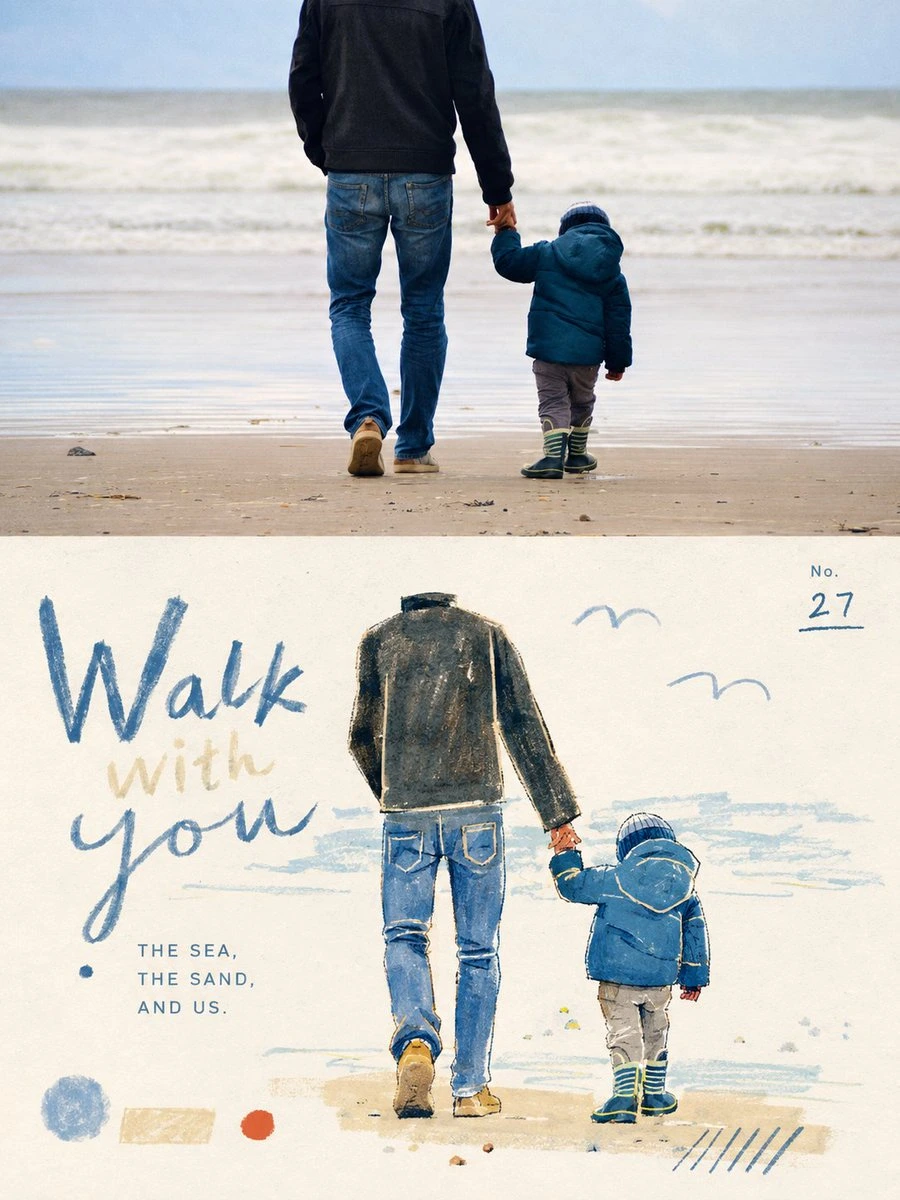
Complete AI image prompt
Build the subject as a paired documentary-and-drawn narrative, with two adjacent fields of nearly equal visual authority. The photographic field captures an unforced real instant with credible people or objects, gesture, contact, setting, ambient light, depth, and natural color; the paper field interprets that same instant instead of tracing it, selecting contours, stripping away the setting, and heightening posture and relationships until they read as an authored emotional annotation. Preserve an immediate correspondence through silhouette, facing direction, touch points, or a shared action axis, so the eye recognizes evidence first and discovers implication in the drawing second. Let the photograph press fully into its field while the drawn subject is isolated by generous paper white; move sparse lettering and symbolic marks toward the margins as light counterweights. Hold an asymmetrical dynamic equilibrium by allowing the drawn figure to slip off the optical center, break an implied column, or send a continuous line beyond the frame. Illustration moves within a tightly controlled range set by the subject's emotional temperature: warmer intimacy uses dry crayon and colored-pencil strokes, short layered marks, translucent blocks, gently naïve proportions, readable expressions, and loosened edges; sharper restraint reduces the subject to hairline black-ink contours, a near-continuous wandering stroke, and the minimum detail needed for recognition. Derive one long connective line from the subject's relationships, resistance, or attachment. It may become a contour, ground cue, or motion path, coil through the figures, tighten into overlaps around the active center, and form a few short barbs only at meaningful pressure points; let it relax into open curves across the surrounding white. Keep it subordinate as a sparse directional trace when the mood is tender, and let it become the governing route when tension rises. Draw the reduced palette from the photographed event: one dominant theme hue, one support hue, and one small warm-cool counteraccent, all quieter and fewer in the illustration; for a more conceptual reading, compress the system to paper white, black ink, and a rare theme-colored mark. Use warm matte natural-fiber paper. Dry pigment may catch and skip within the filled subject so small areas of paper tooth show through, while the ink-only regions remain fine, continuous, and sharply legible and the open field stays luminous. Typography supplies editorial rhythm rather than the subject: pair one large hand-lettered phrase with uneven baseline, changing pressure, and open spacing with tiny typewriter-like captions, numbering, or locational metadata. Adapt stroke anatomy and spacing to the valid structure of the chosen writing system, reduce copy according to the theme's information hierarchy, and keep the photograph-to-drawing correspondence as the first read. The result should feel like a private sketchbook meeting restrained editorial art direction: reality supplies proof, drawing supplies interpretation, and the barbed wandering line makes connection, pull, and pressure visible.
Original style prompt
Build the subject as a paired documentary-and-drawn narrative, with two adjacent fields of nearly equal visual authority. The photographic field captures an unforced real instant with credible people or objects, gesture, contact, setting, ambient light, depth, and natural color; the paper field interprets that same instant instead of tracing it, selecting contours, stripping away the setting, and heightening posture and relationships until they read as an authored emotional annotation. Preserve an immediate correspondence through silhouette, facing direction, touch points, or a shared action axis, so the eye recognizes evidence first and discovers implication in the drawing second. Let the photograph press fully into its field while the drawn subject is isolated by generous paper white; move sparse lettering and symbolic marks toward the margins as light counterweights. Hold an asymmetrical dynamic equilibrium by allowing the drawn figure to slip off the optical center, break an implied column, or send a continuous line beyond the frame. Illustration moves within a tightly controlled range set by the subject's emotional temperature: warmer intimacy uses dry crayon and colored-pencil strokes, short layered marks, translucent blocks, gently naïve proportions, readable expressions, and loosened edges; sharper restraint reduces the subject to hairline black-ink contours, a near-continuous wandering stroke, and the minimum detail needed for recognition. Derive one long connective line from the subject's relationships, resistance, or attachment. It may become a contour, ground cue, or motion path, coil through the figures, tighten into overlaps around the active center, and form a few short barbs only at meaningful pressure points; let it relax into open curves across the surrounding white. Keep it subordinate as a sparse directional trace when the mood is tender, and let it become the governing route when tension rises. Draw the reduced palette from the photographed event: one dominant theme hue, one support hue, and one small warm-cool counteraccent, all quieter and fewer in the illustration; for a more conceptual reading, compress the system to paper white, black ink, and a rare theme-colored mark. Use warm matte natural-fiber paper. Dry pigment may catch and skip within the filled subject so small areas of paper tooth show through, while the ink-only regions remain fine, continuous, and sharply legible and the open field stays luminous. Typography supplies editorial rhythm rather than the subject: pair one large hand-lettered phrase with uneven baseline, changing pressure, and open spacing with tiny typewriter-like captions, numbering, or locational metadata. Adapt stroke anatomy and spacing to the valid structure of the chosen writing system, reduce copy according to the theme's information hierarchy, and keep the photograph-to-drawing correspondence as the first read. The result should feel like a private sketchbook meeting restrained editorial art direction: reality supplies proof, drawing supplies interpretation, and the barbed wandering line makes connection, pull, and pressure visible.
More open images in the “Photo Restyling · Watercolor · Vector · 215” style